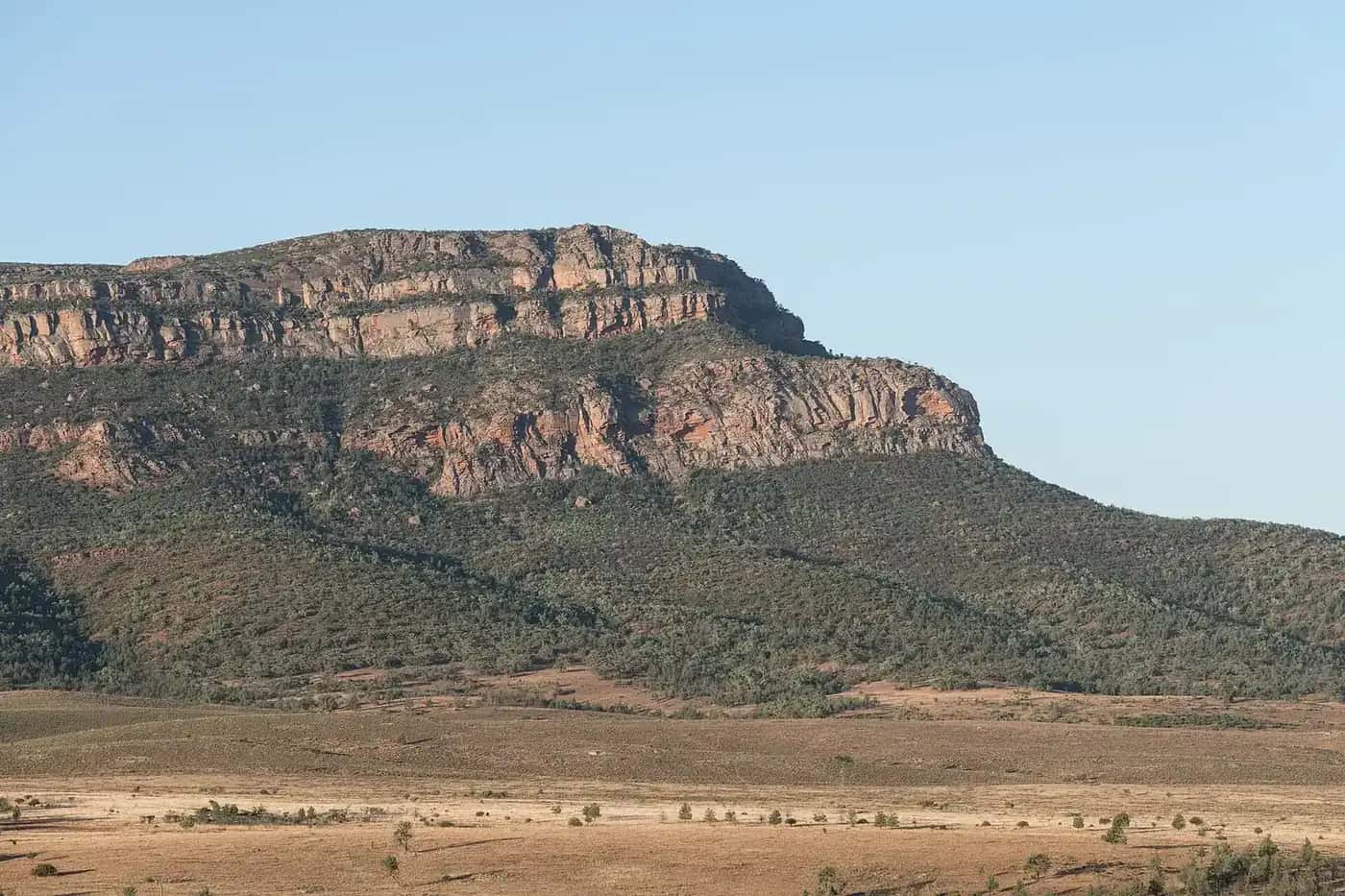
Proclaimed in 2002, Gawler Ranges National Park protects rare and threatened plants and animals in a landscape of rocky ranges, salt-lake country and mallee. National Parks and Wildlife Service SA says the park has more than 400 plant species. Many are at the extreme edge of their range, and some, such as the Gawler Ranges hop bush and Gawler Ranges grevillea, are found nowhere else.
Traditional Owners
The Gawler Ranges People are the recognised Traditional Owners, having attained native title in 2011. National Parks and Wildlife Service SA describes them as a distinct group of foundation families made up of some, but not all, of the Barngarla, Kokatha and Wirangu peoples. The Traditional Owners ask visitors to respect their culture and this ancient landscape.
Highlights
- The Organ Pipes. Rhyolite columns formed more than 1,500 million years ago from volcanic eruptions. The Organ Pipes Walk (1 hour) passes through open eucalypt woodland to a natural amphitheatre. It needs reasonable fitness, because of loose rocks and slippery sections.
- Kolay Mirica Falls and Yandinga Falls. Rocky outcrops and seasonal falls. Yandinga Five Falls is one of the marked walks.
- Conical Hill. A drive with views over ancient sand dunes.
- Heritage sites. Paney Homestead, Old Paney Homestead and Pondanna Outstation recall early station life. The Friends of Gawler Ranges restored Pondanna Outstation, and it's available for short stays.
Other walks include Sturts Waterfall, Stone Dam, Shearers Lookout, the Old Paney Heritage trail, Policemans Point and the Waganny Campground Trail (1 hour 30 minutes).
Wildlife
Look for yellow-footed rock-wallabies, southern hairy-nosed wombats, central long-eared bats, Major Mitchell's cockatoos, Australian ringneck parrots and superb fairy-wrens. National Parks and Wildlife Service SA says the park holds Australia's only protected population of the short-tailed grasswren, a shy bird of the hilltops and ridges. Sand goannas often cross the tracks in the afternoon. Watch for emus and kangaroos on the tracks, especially at sunrise and sunset. See birdwatching.
Camping
The park has six campgrounds. All have toilets, and sites are unallocated. Bring your own drinking water and firewood, because firewood collection is prohibited.
| Campground | Access | Suits |
|---|---|---|
| Chillunie | 4WD only | Camper trailer or tent |
| Kolay Hut | 4WD only | Camper trailer or tent |
| Mattera | 4WD only | Camper trailer or tent |
| Scrubby Peak | High-clearance 2WD in good weather | Caravan, camper trailer or tent |
| Waganny | High-clearance 2WD in good weather | Caravan, camper trailer or tent |
| Yandinga | High-clearance 2WD in good weather | Caravan, camper trailer or tent |
Campfires and generators are allowed, except on days of total fire ban. Gas and liquid-fuel fires are also permitted outside total fire bans.
Fees
National Parks and Wildlife Service SA lists vehicle entry at $14.40 per vehicle and camping at $23.10 per night. Pay before you enter, online or at a booking agent. SA's 2-month and 12-month multi-park passes cover vehicle entry here and at up to 10 other parks.
Getting there
The park is in South Australia's southern Gawler Ranges, about six hours' drive north-west of Adelaide and 40 km north of the Eyre Highway. Road access is from Iron Knob, Kimba, Wudinna or Minnipa. The parks service notes it makes a good stopover for travellers crossing the Eyre Peninsula on the way to Perth. See crossing the Nullarbor and Port Augusta.
Roads and closures
Track conditions change rapidly in wet weather. In 2026, after heavy rain, the parks service closed several waterlogged tracks to all vehicles, and some campgrounds were affected. Check closures and alerts before you go. The park is also closed on days of Catastrophic Fire Danger, and may close on days of Extreme Fire Danger.
On public access routes nearby, remember they're unimproved dirt tracks intended for 4WD access in dry conditions only. When driving on sand, lower your tyre pressures as appropriate, and reinflate them before you leave. Carry a shovel. See 4WD driving and 4WD recovery.
When to visit
National Parks and Wildlife Service SA says late autumn and winter are green and cool, perfect for campfires and bushwalks. After rain the creeks flow. From late winter into spring, the park fills with wildflowers, including the crimson mallee. Summer can be very hot, but it brings calm days, sunsets and clear starry nights. See stargazing and dark skies.
Communications
The parks service says mobile coverage is patchy and unreliable, especially in low-lying areas. Telstra reception is available at the Paney park headquarters office and the Paney Shearing Shed. Download the free park maps in the Avenza app before you arrive, and tell someone your plans.
Rules
Leave pets at home, and don't feed wildlife. There are no bins, so take your rubbish with you. Stay on designated tracks, and respect geological and heritage sites.
Related guides
Related park guide: Lake Gairdner.
Frequently asked questions
Do you need a 4WD for the Gawler Ranges?
National Parks and Wildlife Service SA recommends a 4WD to see all of the park's highlights. In dry weather, much of the park can be reached in a high-clearance 2WD. Three campgrounds (Scrubby Peak, Waganny and Yandinga) suit high-clearance 2WDs and caravans in good weather, and the others are 4WD only. Tracks can close after rain.
How much does it cost to visit Gawler Ranges National Park?
National Parks and Wildlife Service SA lists vehicle entry at $14.40 per vehicle and camping at $23.10 per night. Both must be paid before you arrive. SA multi-park passes can cover vehicle entry.
How were the Organ Pipes formed?
National Parks and Wildlife Service SA says the Organ Pipes formed more than 1,500 million years ago as a result of volcanic eruptions. They're rhyolite columns, and the 1-hour Organ Pipes Walk leads to a natural amphitheatre surrounded by them.
Can you take dogs to the Gawler Ranges?
No. Dogs aren't permitted in Gawler Ranges National Park, although accredited assistance dogs are. National Parks and Wildlife Service SA recommends contacting the park before you visit with an assistance dog.
Sources and further reading
Facts on this page were checked against these primary and official sources. Conditions change — confirm before you travel or buy.
- Gawler Ranges National Park — National Parks and Wildlife Service South Australia
- Closures and alerts — National Parks and Wildlife Service South Australia


