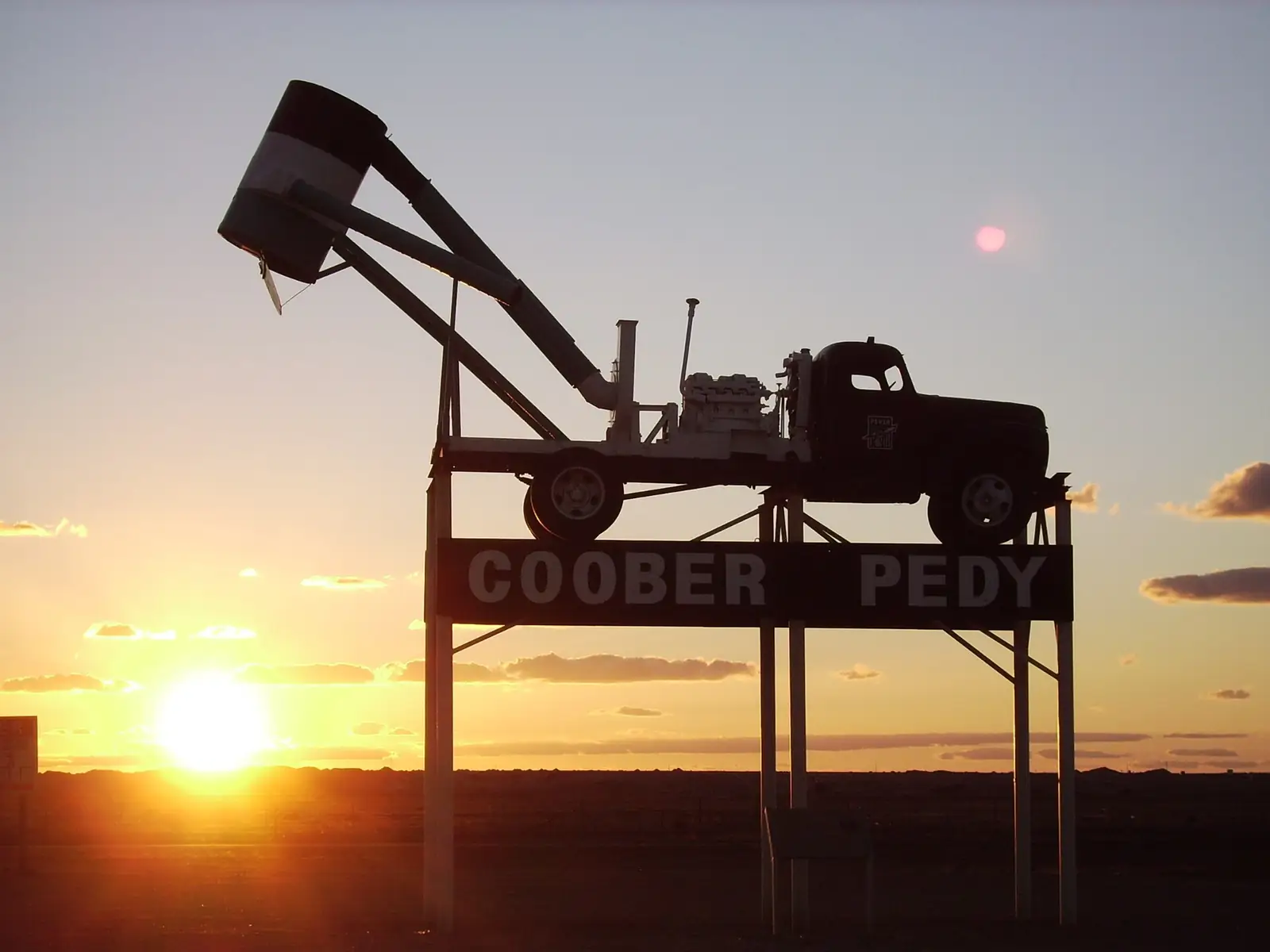
Opal was discovered at Coober Pedy in 1915, and miners soon learned that digging homes into the hillsides was the best way to survive the heat. The town is on Antakirinja Matu-Yankunytjatjara Country, about 850 km north of Adelaide on the Stuart Highway. Its name is commonly said to come from local Aboriginal words often translated as "white man in a hole".
Things to do
Underground living. Visit an underground home, stay in an underground hotel or B&B, and see the underground churches — including the Serbian Orthodox Church and the Catacomb Church.
Opal mine tours and museums. Several mine museums explain how opal forms and is mined, from hand-dug shafts to blowers and tunnelling machines. Buy opal from reputable dealers.
Noodling. Sifting through mullock for opal chips is allowed in designated public areas such as the Jewellers Shop area. Never enter a claim and never walk backwards on the fields.
Kanku-Breakaways Conservation Park. About 30 km north, these colourful mesas and the Moon Plain have starred in many films. A park pass is required.
The Dog Fence. The world's longest fence, built to keep dingoes out of sheep country, crosses the Breakaways road loop.
Desert golf course. Coober Pedy's golf course has no grass; players carry a small square of turf to tee off, and night games use glowing balls.
Crocodile Harry's. The underground dugout home of a colourful local character, now a quirky attraction. Read more in our underground Coober Pedy guide.
Getting there
Drive the sealed Stuart Highway from Port Augusta (about 540 km), fly from Adelaide or take the Ghan to Manguri siding with a transfer on some departures.
History and Country
Coober Pedy lies on the Country of the Antakirinja Matu-Yankunytjatjara people. The name is commonly said to come from local Aboriginal words often translated as "white man in a hole", a reference to the miners' underground homes.
Opal was found here in February 1915 by fourteen-year-old Willie Hutchison, who was travelling with his father's gold-prospecting party. Mining began soon afterwards, and returned soldiers from the First World War helped popularise living underground to escape the heat. The town grew significantly after the Second World War, when migrants from southern and eastern Europe arrived to work the fields, giving Coober Pedy its strongly multicultural character. Coober Pedy has long described itself as the "opal capital of the world".
Why live underground?
Summer days in Coober Pedy are very hot, and winter nights can be cold. Underground rooms — "dugouts" — cut into the hillsides stay at a much more stable temperature year-round without air conditioning. Today dugouts include homes, churches, shops, museums and motels. Staying a night in an underground room is one of the town's most memorable experiences.
A two- to three-day itinerary
Day 1 — Town. Start at the visitor information centre, then visit an underground church (the Serbian Orthodox church is the most spectacular), an underground museum or historic dugout, and an opal mine tour. Watch sunset from the Big Winch lookout.
Day 2 — The Breakaways and Dog Fence. Visit the Kanku–Breakaways Conservation Park, about 30 km north (an entry permit is required; buy it in town), to see the colourful mesas. Continue to the Dog Fence and the Moon Plain on the loop road, returning to town for a night in a dugout.
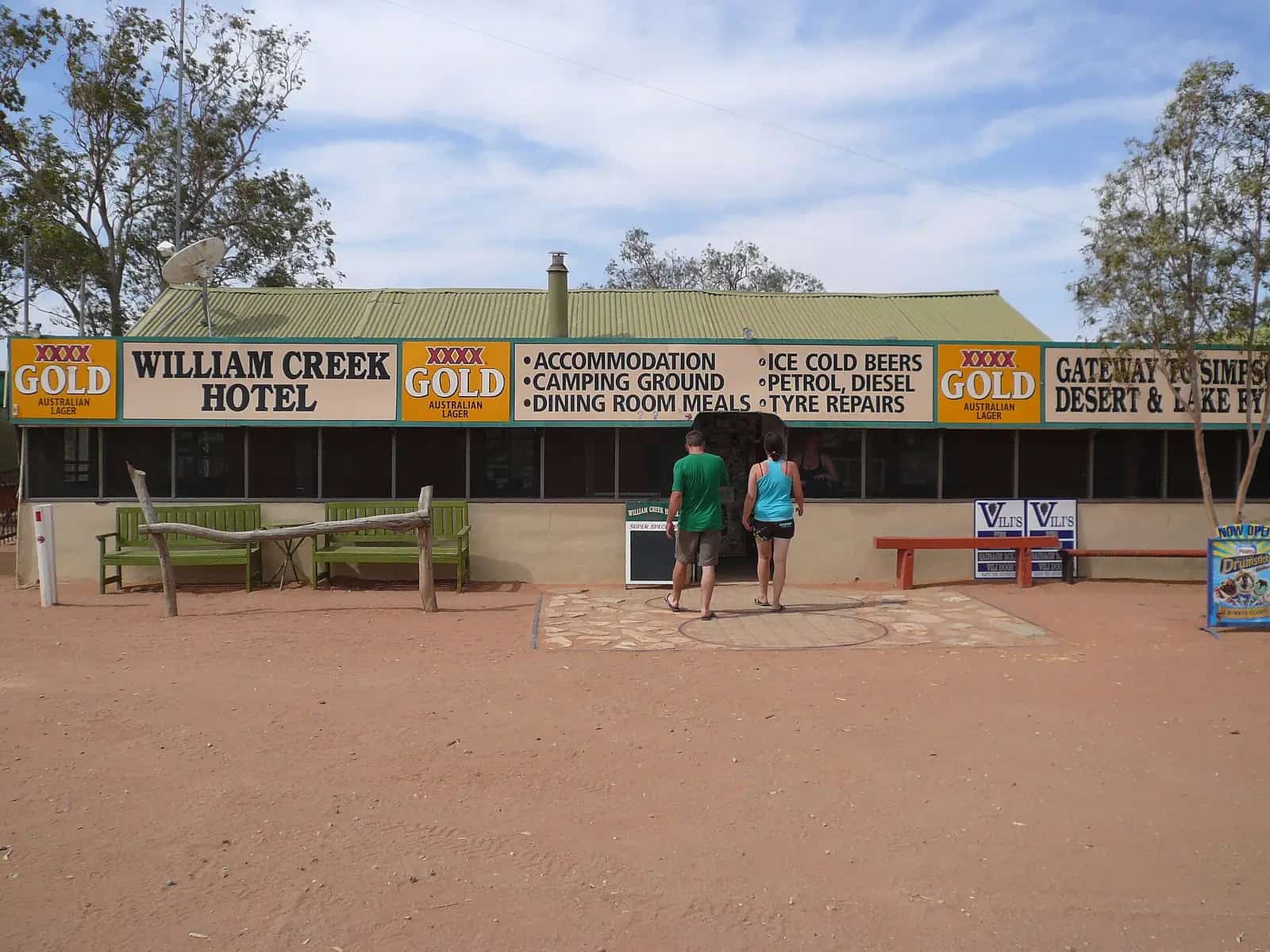
Day 3 (optional) — Further afield. With a suitable vehicle and good conditions, continue to William Creek and Lake Eyre, or take a scenic flight over the region from William Creek.
Fossicking (noodling)
Noodling — sifting through mullock heaps for small opal — is allowed only in designated areas, such as the public noodling area in town. Never noodle on active claims. Opal fields have unfenced shafts; stay on tracks and keep children close.
Seasons
The cooler months from May to September are the most comfortable time to visit. Summer temperatures are extreme, and many tours operate on reduced schedules. Dust storms can occur at any time.
Getting there
- By road: on the Stuart Highway, about 850 km north of Adelaide, sealed. Fuel up at each stop — distances between towns are large.
- By air: Coober Pedy Airport has scheduled flights to Adelaide; check current operators.
- By coach: long-distance coaches have served the Stuart Highway; check current services.
Where to stay and eat
Coober Pedy has underground motels and B&Bs, conventional motels, backpackers and caravan parks — some with underground camping. Restaurants and cafés include pizza, Greek and other cuisines reflecting the town's migrant history. There is a supermarket and fuel. Water is precious here, supplied from a desalination plant; use it carefully.
Underground churches
Coober Pedy's underground churches are among its most remarkable sights. The Serbian Orthodox Church of Saint Elijah the Prophet, carved into the rock, has high ceilings with sculpted walls and stained glass. The Catacomb Church and St Peter and Paul's Catholic Church were among the earliest. Visitors are usually welcome outside service times; dress respectfully and keep noise to a minimum.
On screen
Coober Pedy's lunar landscapes have featured in several films, including Mad Max Beyond Thunderdome, The Adventures of Priscilla, Queen of the Desert and Pitch Black. A spaceship prop left behind after filming is displayed in town and is a popular photo stop.
The Painted Desert
About 230 km north-east, the Arckaringa Hills — often called the Painted Desert — are a range of eroded hills banded in reds, oranges, white and ochre. Access is via unsealed roads through Arckaringa Station, which operates camping; conditions vary, so ask in Coober Pedy before going.
Opal buying tips
- Ask whether a stone is a solid, a doublet or a triplet, and get a written description.
- Look at the stone in natural light, and turn it to see how the colour changes.
- Deal with established, reputable sellers.
Travelling with kids
Children enjoy underground homes, noodling for opal and the town's quirky sights. Keep a close eye on them anywhere near mine shafts — warning signs are posted across the fields for good reason.
Respecting the community
Coober Pedy is a working mining town. Do not wander onto claims, photograph private homes without permission, or enter dugouts uninvited.
The top things to do
- Umoona Opal Mine & Museum. It says it's Coober Pedy's largest underground tourist attraction, operating since the 1920s. The underground museum is free, and it covers opal mining history, Aboriginal heritage and opal geology, with a documentary in an underground cinema. Guided mine tours run at 10 am, 2 pm and 4 pm, and it's open daily from 8:30 am to 5:30 pm. It notes the underground stays at around 22–24°C all year.
- Old Timers Mine. Hand-dug in 1916, it offers a self-guided walk through display galleries, two underground homes and seams of opal.
- The underground churches. These include the Serbian Orthodox Church of Saint Elijah the Prophet.
- Kanku-Breakaways Conservation Park. About 25 km north, it's Aboriginal-owned, and the entire park is a registered Aboriginal heritage site. It's co-managed by the Antakirinja Matu-Yankunytjatjara Aboriginal Corporation, the District Council of Coober Pedy and SA's Department for Environment and Water. National Parks and Wildlife Service SA lists the vehicle entry permit at $13.50 ($11.20 concession). Book online, or buy one from the visitor centre or Underground Books. See the Kanku-Breakaways guide.
- The Dog Fence and the Moon Plain, beyond the Breakaways.
- Coober Pedy Drive-In. One of the last surviving drive-ins in Australia, built in 1965.
- Umoona Arts Centre. An Indigenous-owned, member-run art studio.
- Noodling in the public area. Ask the visitor centre where it's allowed.
- Golf. The town's desert course is played on dirt fairways.
- Opal shopping. The town has some of the world's largest opal displays. See our opal buying tips above.
Coober Pedy at night
Evenings are quiet, but there's a sunset over the opal fields, a meal at an underground restaurant, and the drive-in on its screening nights. Stay out of the fields after dark (see safety below), and sleep underground, where it's cool and silent.
Is Coober Pedy worth visiting?
Yes. There's nowhere else like it. Many people live, worship and stay underground, and the town is on the Stuart Highway, so it's an easy stop between Adelaide and Uluru. The visitor centre estimates around 150,000 tourists visit each year.
Where to stay
Accommodation types include underground hotels and motels, dugout B&Bs and apartments, backpacker dugouts, above-ground motels, and caravan parks, some of which have underground camping areas. Sleeping underground is the signature experience.
Visitor centre
The Coober Pedy Visitor Information Centre is in the District Council offices on Hutchison Street, at the southern entrance to town. It books tours and accommodation, sells Breakaways permits, and has road information. Check current opening hours before you go, because summer hours may differ.
Getting there by train or air
The Ghan stops at Manguri, about 37 km from town, according to local tourism information. Rex flies to Coober Pedy, and Greyhound coaches serve the town. Note that rest stops on the Stuart Highway near Coober Pedy are for temporary stops only, with no overnight stays.
Practical information
Coober Pedy has fuel, supermarkets, a hospital and plenty of accommodation. Summer heat is extreme; April to October is best. Respect "danger" signs on the fields.
Explore nearby
See fossicking and gem fields and the Coober Pedy mail run in scenic flights and air tours.
Further north: the Painted Desert on Arckaringa Station.
Frequently asked questions
How many people live underground in Coober Pedy?
A large share of residents live in dugouts — homes cut into the hillsides — though exact figures vary by source. Underground homes stay at a comfortable temperature year round while surface temperatures can be extreme.
How many days do you need for Coober Pedy?
One to two full days lets you visit an opal mine and museum, an underground church, the Breakaways and the Dog Fence. Many travellers on the Stuart Highway stay one or two nights.
Is Coober Pedy safe at night?
Coober Pedy is generally safe for visitors, but take normal precautions, stay on roads and marked paths, and never walk on the opal fields at night — there are thousands of unmarked shafts.
Can you drink the water in Coober Pedy?
The town supply is treated bore water from the Great Artesian Basin, processed by desalination; check current advice locally. Water is precious here, so use it sparingly.
What are the top things to do in Coober Pedy?
Tour an opal mine (Umoona or Old Timers), visit the underground churches, see the Kanku-Breakaways and the Dog Fence, noodle for opal, catch a film at the drive-in, visit the Umoona Arts Centre and sleep underground.
Is Coober Pedy worth visiting?
Yes. Its underground homes, churches and hotels, opal fields and the Breakaways make it one of Australia's most unusual towns, and it's right on the Stuart Highway between Adelaide and Uluru.
Sources and further reading
Facts on this page were checked against these primary and official sources. Conditions change — confirm before you travel or buy.
- Coober Pedy tourism — District Council of Coober Pedy
- Kanku-Breakaways Conservation Park — National Parks and Wildlife Service SA
- Opal fields safety — Department for Energy and Mining SA
- Umoona Opal Mine & Museum — Umoona Opal Mine & Museum
- Attractions — Coober Pedy tourism
- Travel information — Coober Pedy