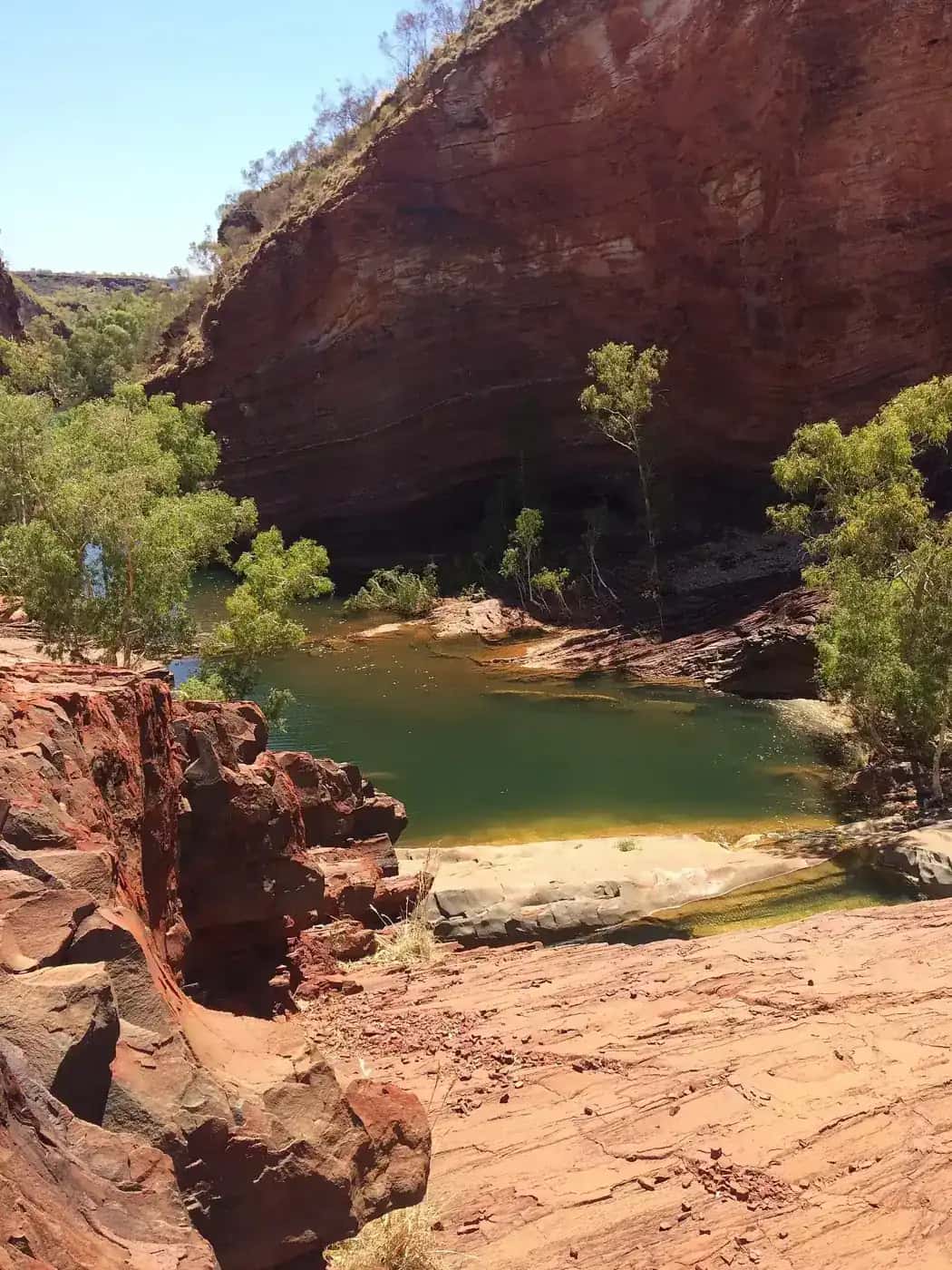
Karijini is Western Australia's second-largest national park, covering more than 6,000 square kilometres. It is jointly managed with the Banyjima, Kurrama and Innawonga peoples, whose Country it is. The park lies near Tom Price.
Geology
Karijini's gorges cut through banded iron formations laid down on an ancient sea floor around 2.5 billion years ago. The layers of red, brown and blue-grey rock record some of the earliest chapters of Earth's history.
Highlights
- Dales Gorge — Fortescue Falls, Fern Pool (Jubura) and Circular Pool, with walks from easy to moderate.
- Weano Gorge and Handrail Pool — a narrow chasm with a handrail descent.
- Hancock Gorge and Kermit's Pool — a challenging route requiring wading and scrambling.
- Oxer and Junction Pool lookouts — where four gorges meet.
- Joffre Gorge and Falls — a curved amphitheatre waterfall.
- Hamersley Gorge — folded rock layers and a spa pool, in the park's west.
- Mount Bruce (Punurrunha) — WA's second-highest peak, with a summit walk.
Trail classes
Walks are graded from Class 1 (easy) to Class 6 (very difficult, requiring experience). Respect the ratings, wear good shoes and never enter gorges when rain threatens.
Camping and accommodation
Dales campground (book through Parks WA) and the Karijini Eco Retreat near Weano. Tom Price has more options.
Gorge safety
Karijini's gorges are beautiful but can be dangerous. Rock surfaces are slippery, some routes involve climbing, wading and swimming in cold water, and flash floods can occur with little warning when storms hit upstream. People have died in the gorges. Respect the trail classes, wear good shoes with grip, carry water and never enter a gorge if rain is forecast. Check the Karijini Visitor Centre and Parks WA alerts for closures. Read our outback safety guide.
Karijini Visitor Centre
The visitor centre, built in a shape inspired by a goanna moving through the country, has displays on Banyjima, Kurrama and Innawonga culture, the park's geology and wildlife. It is a good first stop for information on gorge conditions and walking routes.
Wildlife and plants
Look for rock wallabies, red kangaroos, euros, echidnas and many birds, including spinifex pigeons and red-tailed black cockatoos. Spinifex grasslands, snappy gums and mulga cover the plateau, while ferns and figs grow in the moist gorges. Wildflowers bloom after rain, especially in late winter and spring.
Getting there
Karijini lies in the Hamersley Range, between Tom Price and Newman. The main roads through the park are sealed, but roads to Weano and some other gorges are unsealed. The park is a highlight of the inland Perth to Darwin route. Fuel is available at Tom Price, Newman and the Auski Roadhouse; there is no fuel in the park.
Traditional Owners
The Banyjima, Kurrama and Innawonga peoples are the Traditional Owners of Karijini, and the park is jointly managed with them. Karijini is the Banyjima name for the Hamersley Range. Respect cultural sites and closures.
Suggested three days
Day one. Walk Dales Gorge, swim at Fern Pool and Fortescue Falls, and camp at Dales.
Day two. Visit Oxer and Junction Pool lookouts, then explore Weano Gorge and Handrail Pool.
Day three. Climb Mount Bruce at dawn, then drive to Hamersley Gorge for a swim on the way to Tom Price.
What to bring
Water, sun protection, sturdy shoes, swimwear, a first aid kit and a torch. Mobile coverage is limited; consider a satellite device for remote walks.
Trail classes explained
Karijini uses a trail classification system to help visitors choose walks safely. Class 1 and 2 tracks are short and suitable for most people. Class 3 and 4 tracks involve uneven ground, steps and some rock-hopping. Class 5 tracks require scrambling, wading and good fitness. Class 6 routes, such as parts of Hancock and Weano gorges beyond certain points, involve climbing and swimming in cold water and should only be attempted by experienced, fit walkers with appropriate gear. If in doubt, choose an easier walk; the views from lookouts are spectacular in themselves.
Accommodation outside the park
If campgrounds are full, Tom Price has a tourist park, hotel and motel, and Auski Roadhouse at Munjina has rooms and camping. Booking ahead in the cooler months is strongly recommended.
Mount Meharry
Mount Meharry, in the eastern part of the park, is the highest point in Western Australia. Reaching it involves rough 4WD tracks and a steep walk; it is best attempted only by well-prepared, experienced visitors with a high-clearance vehicle. Check Parks and Wildlife Service WA for current access before going, as tracks may be closed.
Heat and closures
Summer in the Pilbara brings extreme heat, and some gorge walks may be closed in high temperatures or after heavy rain. Cyclones and tropical lows can cause flooding and road closures between about December and April. Check the park alerts and Main Roads WA before travelling.
Photography and drones
Light reaching the bottom of the gorges is best in the middle of the day, when sunlight penetrates the narrow walls. Drone use in WA national parks requires approval from Parks and Wildlife Service WA, and drones are not appropriate in the gorges where other visitors are swimming and walking.
Related guides
Karijini is the centrepiece of the Pilbara region.
Also in the Pilbara: Millstream Chichester National Park. Plan with the Western Australia road trip.
Frequently asked questions
When is the best time to visit Karijini?
The cooler months from about May to September. Summer is very hot, and heavy rain from tropical storms and cyclones can cause flash flooding in the gorges.
How far is Karijini from Tom Price?
The park's western entrance is about 50 km from Tom Price, and the main gorges are about 1 to 1.5 hours' drive.
Can you swim at Karijini?
Yes, in several pools, including Fern Pool and Fortescue Falls in Dales Gorge, Handrail Pool and Hamersley Gorge. The water is cold, and some pools close at times. Follow signs.
Is Karijini suitable for children?
Many walks, such as the Dales Gorge rim walk and Fortescue Falls, suit families. Harder Class 5 and 6 routes in Weano and Hancock gorges are not suitable for young children.
When is the best time to visit Karijini?
The cooler months from about April to September. Summer temperatures are extreme, and storms can cause flash flooding.
Sources and further reading
Facts on this page were checked against these primary and official sources. Conditions change — confirm before you travel or buy.
- Karijini Visitor Centre — Parks and Wildlife Service WA
- Karijini National Park — Explore Parks WA


