Purnululu National Park lies in the East Kimberley, between Kununurra and Halls Creek. It is the Country of the Kija and Jaru peoples. The park was listed as a World Heritage Area in 2003 for its outstanding natural values, and its significance to Aboriginal people is recognised.
The domes
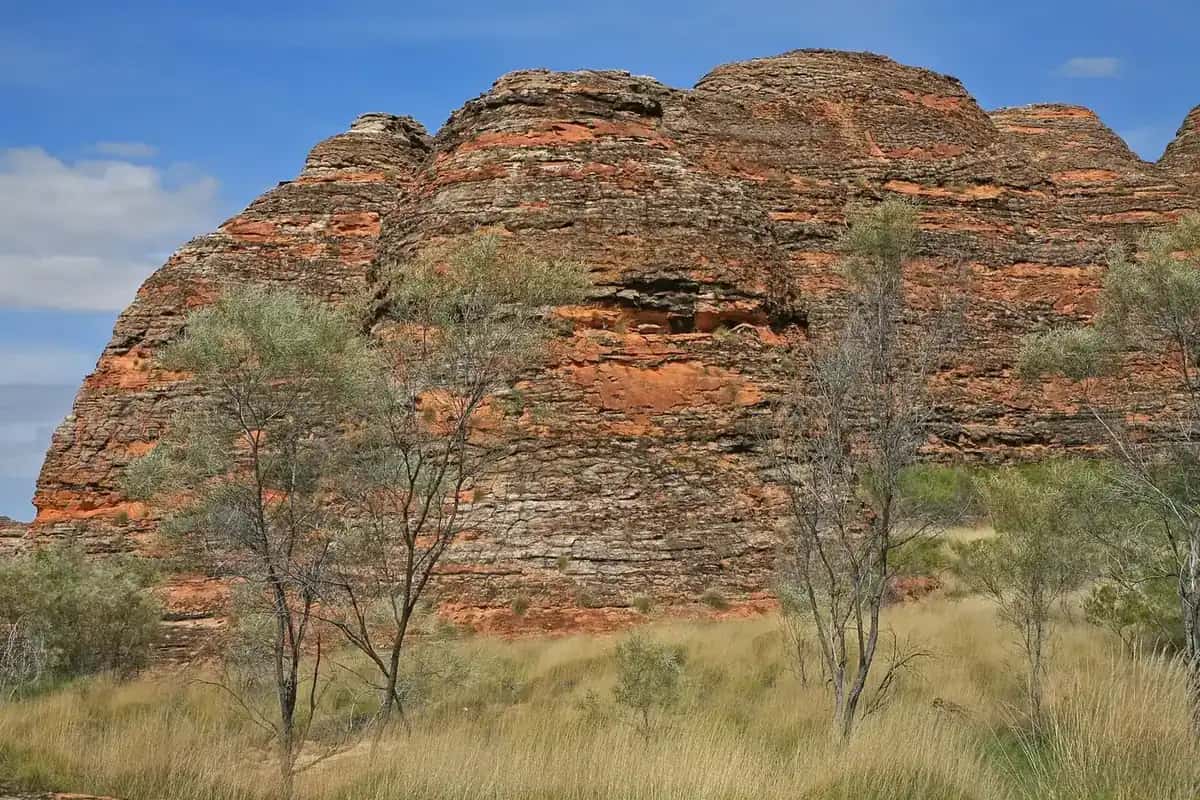
The Bungle Bungle domes are sandstone towers banded with orange and dark grey stripes. The orange bands are coloured by iron oxides, while the grey bands are coloured by cyanobacteria growing in layers that hold more moisture. The domes were little known outside the region until the 1980s.
Highlights
- Cathedral Gorge — a huge natural amphitheatre with remarkable acoustics.
- Piccaninny Creek and Gorge — longer walks into the southern domes.
- Echidna Chasm — a narrow, towering chasm in the north, glowing in the midday sun.
- Mini Palms Gorge — a walk through palms into a narrow gorge.
- Scenic flights — fixed-wing and helicopter flights over the domes.
Camping
Walardi and Kurrajong campgrounds, bookable through Parks WA. There are no supplies in the park.
Safety
The access track has river crossings and rough sections; trailers are not permitted. Carry water on all walks, and avoid the heat of the day.
Getting into the park
Access to Purnululu is via the Spring Creek Track, which leaves the Great Northern Highway between Halls Creek and Kununurra. The track is about 53 km long, with creek crossings, steep sections and corrugations, and is suitable only for high-clearance 4WD vehicles. Caravans and trailers are not allowed; there is a caravan park near the turnoff where you can leave them. The park is closed in the wet season.
Walks
- Cathedral Gorge. About 3 km return, through the domes to a vast, echoing amphitheatre.
- Domes walk. A short loop among the beehive-shaped domes.
- Piccaninny Creek and Gorge. Longer walks along a creek bed; overnight walks require registration and preparation.
- Echidna Chasm. About 2 km return in the north of the park, into a narrow chasm where the walls glow orange around midday.
- Mini Palms Gorge. A walk into a gorge filled with Livistona palms.
- Kungkalanayi Lookout. A short walk to a sunset viewpoint over the range.
Geology
The domes are made of sandstone and conglomerate deposited hundreds of millions of years ago and later eroded into their distinctive beehive shapes. The stripes come from alternating layers: iron oxides colour the orange bands, while cyanobacteria grow on layers that hold more moisture, forming darker bands. The sandstone is fragile; never climb on the domes.
Kija and Jaru Country
Purnululu means "sandstone" in the Kija language. The Kija and Jaru peoples have lived in this region for many thousands of years, and the park is managed with Traditional Owner involvement. Some areas are culturally restricted.
Scenic flights
Helicopter flights from inside the park and fixed-wing flights from Kununurra, Halls Creek and Warmun give an unforgettable view of the domes. Flights are a good option if you do not have a suitable 4WD.
Camping
Walardi (south) and Kurrajong (north) campgrounds must be booked through Parks WA. Bring all food, water and fuel; there are no supplies in the park. Park entry fees apply.
Seasons
The best time is the early dry season, around April to June, when waterholes still hold water and temperatures are lower. Later in the dry season, temperatures climb.
Suggested two days
Day one. Drive in early, visit the visitor centre and walk Echidna Chasm around midday, then watch sunset from Kungkalanayi Lookout.
Day two. Walk Cathedral Gorge and the Domes in the morning, then drive out or take a helicopter flight.
A recent "discovery"
Although Kija and Jaru people have always known the range, the Bungle Bungles were little known to the wider Australian public until the early 1980s, when aerial footage brought them to national attention. The national park was declared in 1987, and World Heritage listing followed in 2003.
What to bring
Carry at least two spare tyres, recovery gear, plenty of water, food for your entire stay and a first aid kit. Mobile coverage is very limited.
Art of the east Kimberley
The country around Purnululu has a strong art tradition. Warmun Art Centre, in the community of Warmun on the Great Northern Highway, represents Gija artists known for their ochre paintings of Country. Visiting requires checking opening hours and protocols with the art centre. See Buying Aboriginal art ethically.
Photography
The orange-and-black banding on the domes is most vivid in the soft light of early morning and late afternoon. Inside Cathedral Gorge, light reflecting off the walls creates a warm glow in the middle of the day. Drone use in WA parks requires approval from Parks and Wildlife Service WA.
Fuel and supplies
There is no fuel or shop in the park. The nearest fuel is at the roadhouses on the Great Northern Highway, including Warmun and the Bungle Bungle turn-off area, and in Halls Creek and Kununurra. Carry enough fuel for the return drive along the Spring Creek Track and around the park.
Related guides
See the Bungle Bungles from the air with scenic flights and air tours, or plan a Gibb River Road itinerary that includes Purnululu.
Frequently asked questions
How long is the drive into Purnululu?
The Spring Creek Track is about 53 km from the highway to the visitor centre and usually takes one to two and a half hours, depending on conditions.
Can you drive into the Bungle Bungles in a 2WD?
No. The Spring Creek Track from the Great Northern Highway is suitable only for high-clearance 4WD vehicles, and trailers and caravans are not permitted.
When is Purnululu National Park open?
The park usually opens in early April and closes in the wet season, generally around December, because the access track becomes impassable. Check Parks WA for current dates before planning.
How do you get to Purnululu?
Via the Spring Creek Track off the Great Northern Highway, about 53 km of rough 4WD-only track to the visitor centre. Many visitors take scenic flights from Kununurra, Warmun or Halls Creek instead.
When is Purnululu open?
The park is generally open only in the dry season, roughly April to December, depending on conditions. Check Parks WA alerts.
Sources and further reading
Facts on this page were checked against these primary and official sources. Conditions change — confirm before you travel or buy.
- Purnululu National Park — Explore Parks WA
- UNESCO World Heritage — Purnululu — UNESCO


