Every year search-and-rescue teams are called to help travellers who ran out of fuel, got bogged on a closed road or walked away from a broken-down car in the heat. Almost every one of those incidents was preventable. The good news is that the habits that keep you safe are simple, and they quickly become second nature.
Plan the trip, then share it
Before you leave, map your route day by day, noting the distance between fuel stops, where you will stay and which sections are unsealed. Check the official road conditions service for each state you will cross: Live Traffic NSW, QLDTraffic, SA's outback road warnings, the NT Road Report and Main Roads WA's travel map. Look at the Bureau of Meteorology forecast and any warnings for heat, storms, fire and flooding.
Then tell someone. Leave your route, vehicle details and expected arrival times with a friend or family member, and agree when they should raise the alarm. For genuinely remote tracks, many travellers also check in with the police station or roadhouse at either end.
Water: carry more than you think
Water is the single most important item in your vehicle. In hot weather you can lose large amounts of fluid without noticing. Remote-travel guidance from state governments commonly suggests carrying enough for several days beyond your plans, and a rule of thumb of at least 5–7 litres per person per day in the heat. Split it between several containers so a single leak does not leave you dry, and keep some inside the cabin rather than all on the roof.
Do not rely on rivers, waterholes or bores. Many are dry, salty or reserved for stock, and some bores deliver very hot water.
Fuel: fill up every time
On remote routes the distance between fuel stops can exceed 200 km, and roadhouses can be closed, out of a fuel type or accept limited payment methods. Fill up at every opportunity, know your vehicle's real range (which drops when towing, on sand or into a headwind) and carry a reserve in approved jerry cans if your route needs it.
Heat
Outback summers are extreme. Heat stress can escalate to heatstroke, which is a medical emergency. Travel in the cooler months where possible; in hot weather, drive early, rest in shade through the afternoon, wear a hat and loose clothing, and drink regularly. Learn the warning signs — headache, dizziness, nausea, confusion, hot dry skin — and act early. Never leave children or pets in a parked car.
Wildlife and livestock
Kangaroos, emus, wallabies, wombats, cattle and feral camels and goats wander onto outback roads, particularly from dusk to dawn. Plan to be off the road by late afternoon. If an animal appears, brake firmly in a straight line rather than swerving — swerving at speed is a common cause of rollovers. Much outback grazing land is unfenced, so expect stock on the road.
Road trains and heavy vehicles
Road trains of three or four trailers are a normal sight on outback highways. They are long, heavy and cannot stop or swerve quickly. Give them room, never cut in front, and only overtake with a long, clear straight. On narrow roads, slow down and move onto the shoulder — carefully — to let them pass, as they throw up stones and dust.
Unsealed roads and closures
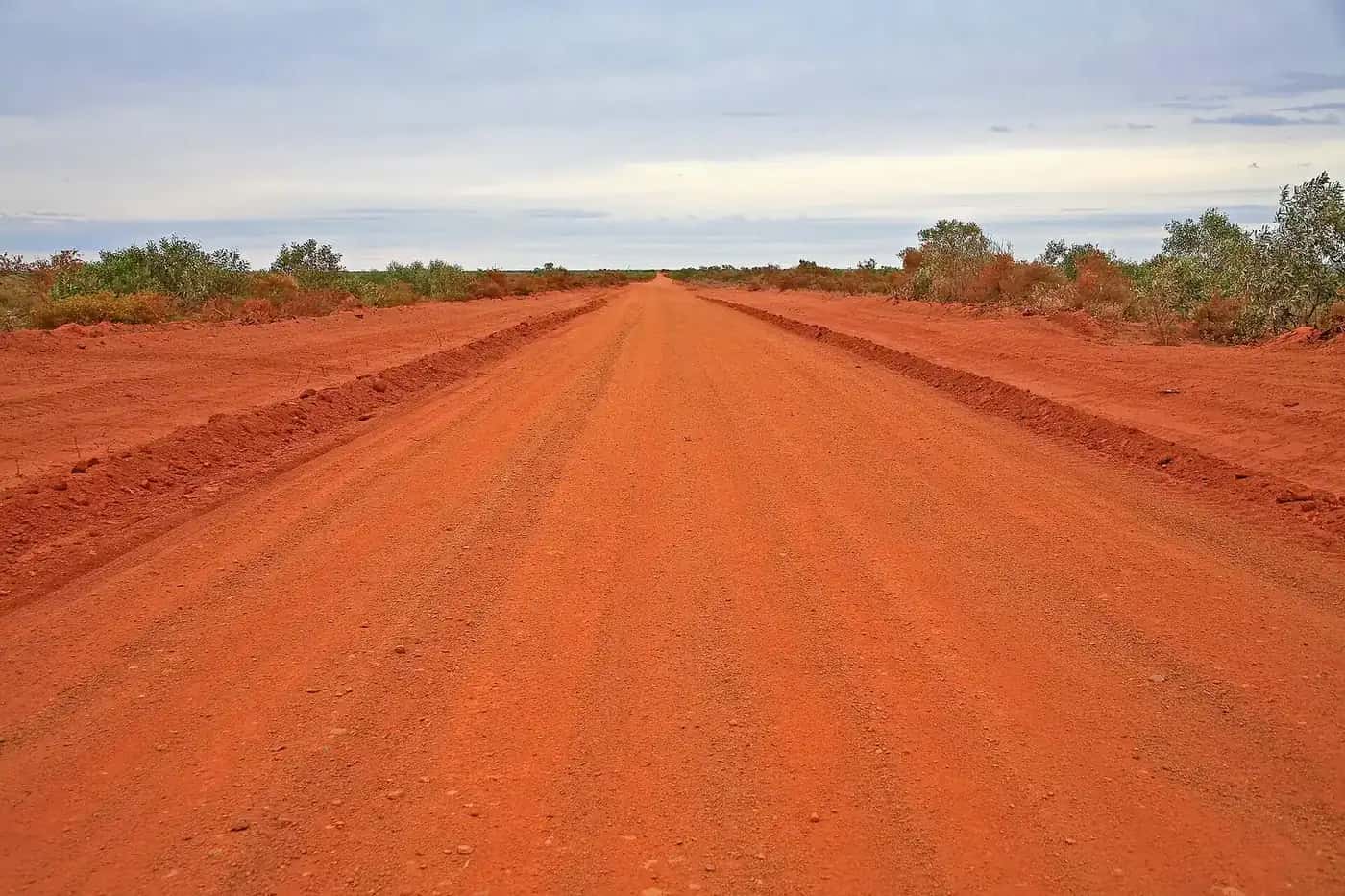
Many outback roads are gravel or dirt. They range from smooth and wide to badly corrugated, sandy or rocky. Lower your speed, increase following distances, drive with headlights on and adjust tyre pressures for conditions — see our 4WD driving guide. After rain, unsealed roads can become impassable and are formally closed. Driving on a closed road can bring large fines in Queensland, South Australia and NSW and causes expensive damage. Wait it out — towns are used to stranded travellers.
Fatigue
Long, straight, empty roads are monotonous. Stop every two hours, share the driving and avoid the post-lunch slump. If you feel drowsy, pull over at a rest area and sleep — there is no shame in a power nap.
Communications
Mobile coverage in the outback is mostly limited to towns and nearby highways. For travel beyond that, carry at least one of:
- a personal locator beacon (PLB), registered with the Australian Maritime Safety Authority;
- a satellite communicator or satellite-enabled phone that can send SOS messages and texts;
- a satellite phone.
A UHF CB radio is useful for talking with road train drivers and other travellers nearby; channel 40 is commonly used by trucks on highways.
If you break down
- Stay with your vehicle. It is far easier to find from the air and gives shade.
- Call for help using your satellite device or PLB. If you have coverage, call 000.
- Conserve water and energy. Rest in the shade in the heat of the day and avoid exertion.
- Make yourself visible. Raise the bonnet, lay out bright items, use a mirror to signal aircraft and light a smoky fire only if it is safe and legal to do so.
- Do not walk for help unless you are certain of a short distance to assistance and conditions are cool.
Vehicle preparation
Get your vehicle serviced before the trip, telling the mechanic you are going remote. Carry at least one spare tyre (two for remote tracks), a jack and base plate, tyre repair kit, compressor, tools, spare belts and hoses, fuses and coolant. Know how to change a tyre on your vehicle before you need to.
First aid and health
Pack a comprehensive first-aid kit including snakebite bandages, and consider a remote-area first-aid course. Bring enough prescription medication for the trip plus extra. The Royal Flying Doctor Service provides emergency medical care across remote Australia — but the best help is not needing it.
A quick pre-departure checklist
- Route planned and shared, with check-in times
- Road conditions and weather checked
- Fuel range known and full tank
- Water: several days' supply for everyone
- Food for extra days
- PLB or satellite device, charged and registered
- Paper maps as a backup to GPS
- Spare tyre(s), tools and recovery gear
- First-aid kit and medication
- Sun protection and warm clothing for cold nights
Further reading
- Remote-area travel safety: communications, trip plans and emergencies
- Fuel, permits and road conditions
- Crocodile safety
- Snakes and first aid
Go deeper with travelling in summer heat, water and food planning, 4WD recovery and wet season and road closures.
Know the rules: outback road rules and sharing the road with road trains.
Frequently asked questions
How much water should I carry in the outback?
Official remote-travel advice commonly recommends carrying enough drinking water for every person for several days beyond your planned trip, with a rule of thumb of at least 5 to 7 litres per person per day in hot conditions. Carry it in more than one container.
What should I do if my car breaks down in the outback?
Stay with your vehicle. It provides shade and is much easier to spot from the air. Use your satellite phone, messenger or personal locator beacon to call for help, ration your water, rest in the shade during the day and use signals such as a mirror or bright clothing to attract attention.
Do I need a personal locator beacon in the outback?
If you are travelling off main highways or in areas without mobile coverage, a registered 406 MHz personal locator beacon (PLB) or a satellite communicator is strongly recommended. Register your PLB with AMSA so rescuers have your details.
Is it safe to drive in the outback at night?
It is best avoided. Kangaroos, emus, wombats, cattle and camels are hard to see and most active from dusk to dawn. Collisions can be fatal and can leave you stranded far from help.
What is the emergency number in Australia?
Call Triple Zero (000). From a mobile you can also dial 112. If you have no coverage, activate a PLB or use a satellite device.
Sources and further reading
Facts on this page were checked against these primary and official sources. Conditions change — confirm before you travel or buy.
- Remote travel safety — Northern Territory Government
- Personal locator beacons — register your beacon — Australian Maritime Safety Authority
- Triple Zero (000) — Australian Government
- Outback road warnings — Department for Infrastructure and Transport SA
- Heatwave and heat health — healthdirect Australia
- Road trains — National Heavy Vehicle Regulator

