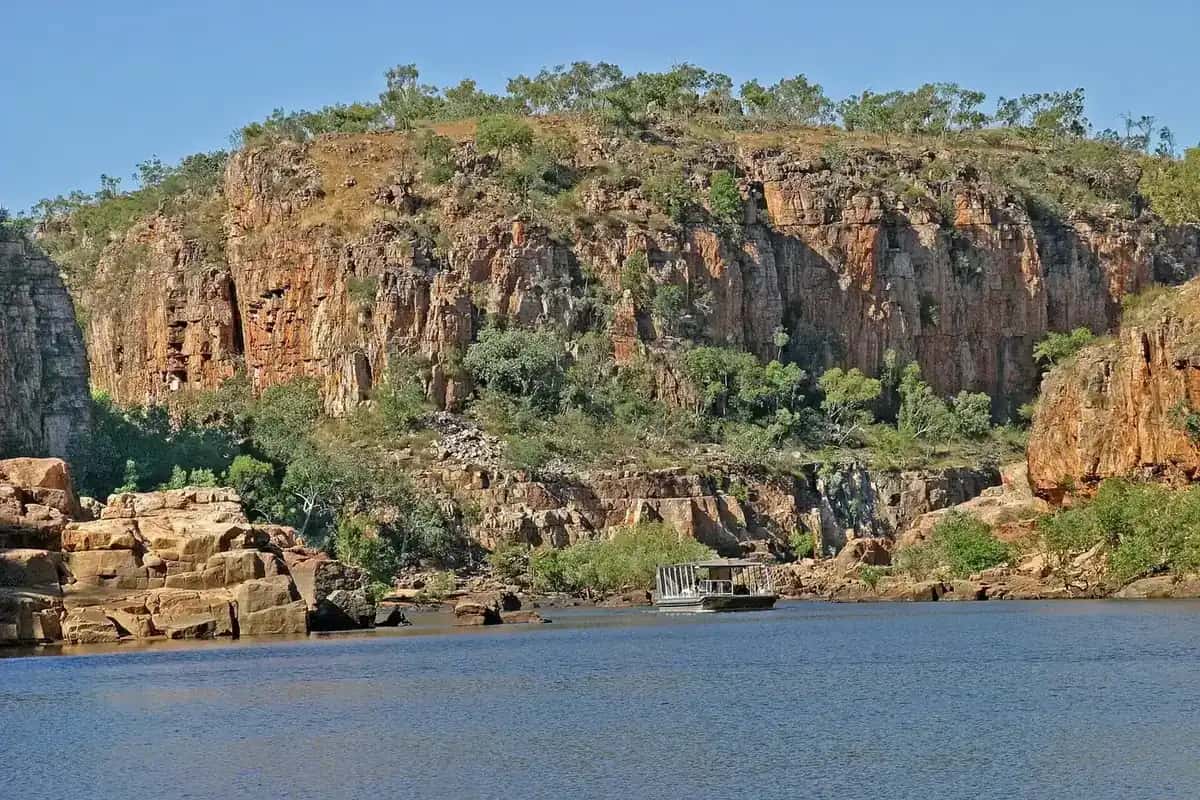
Kakadu is one of Australia's largest national parks and one of its most significant cultural places. Parks Australia's visitor guide notes that one-third of Australia's bird species are found in the park. Ancient rock art shows long-extinct animals. The name "Kakadu" comes from Gagudju, one of the languages spoken in the north of the park. Other languages used in the park today include Kunwinjku and Kundjeyhmi.
Like Litchfield, Kakadu is tropical Top End country rather than desert. It's a natural extension of any Northern Territory road trip.
The seven regions
Parks Australia divides the park into seven regions:
- East Alligator (Erre): home of Ubirr's rock art and its famous sunset lookout.
- Jabiru: the township, with services and the Bowali Visitor Centre nearby.
- Jim Jim and Twin Falls: dramatic escarpment waterfalls, closed in 2026 (see below).
- Mary River: savanna woodland in the south-west.
- Burrungkuy (Nourlangie): a major rock art site and lookouts.
- South Alligator: river country in the centre-north.
- Yellow Water (Ngurrungurrudjba): wetlands and the Yellow Water cruises, near Cooinda.
The far south, including Gunlom, has plunge pools and escarpment walks. Gunlom was scheduled to reopen on 1 July 2026.
2026 closures
Parks Australia says the Jim Jim and Twin Falls area is closed for all of 2026. That includes Jim Jim Falls (Barrkmallam), Twin Falls gorge, the Twin Falls plateau walk, the Barrk Marlam walk and Karnamarr campground. Cyclones caused substantial damage to roads. Upgrade works were scheduled from June to December 2026, ahead of reopening for the 2027 dry season.
Ubirr and Burrungkuy (Nourlangie) are open. Parks Australia lists Burrungkuy's rock art site gates as open from 7 am to 7 pm daily. Always check the Kakadu access report before you go, because sites open progressively after each wet season under the Park Opening Plan.
Park passes
You need a park pass to enter Kakadu. It covers entry, ranger-guided activities and information, and a large portion goes to Bininj/Mungguy Traditional Owners.
| Pass | Dry season (15 May–31 Oct) | Tropical summer (1 Nov–14 May) |
|---|---|---|
| Adult (16+) | $40 | $25 |
| Child (5–15) | $20 | $12.50 |
| Family (2 adults + 2 or more children) | $100 | $65 |
| Concession | $30 | $19 |
In June 2026, Parks Australia announced that passes for 1 July to 31 October 2026 would be charged at the lower wet-season rates. NT residents with proof of residency don't need a pass, but checks take place and penalties apply. The Kakadu pass doesn't cover Uluru-Kata Tjuta or NT Government parks such as Litchfield.
How many days?
Parks Australia publishes 3-day and 5-day itineraries. A practical 3-day outline:
- Day 1: drive from Darwin to Jabiru (about 250 km, roughly 3 hours). Visit the Bowali Visitor Centre.
- Day 2: Ubirr rock art and the sunset lookout, plus an East Alligator River cultural cruise.
- Day 3: a Yellow Water cruise at Cooinda, then Burrungkuy (Nourlangie).
With 5 days or more, add the southern sites such as Gunlom and Yurmikmik, where open. In other years, add Jim Jim and Twin Falls in the late dry season (by 4WD).
Yellow Water cruises
Parks Australia lists Yellow Water cruises running up to six times a day, lasting 90 to 120 minutes. They're one of the best ways to see crocodiles and birdlife. Book sunrise and sunset cruises ahead in the dry season.
Seasons
Bininj/Mungguy recognise six seasons in Kakadu. Parks Australia uses two broad seasons for planning: the dry (around May to October) and the tropical summer (November to April). The park is open all year, but rainfall and flooding make some areas inaccessible in the tropical summer. That's also when the waterfalls are at their biggest, and scenic flights show them best. See scenic flights and air tours and the wet season and road closures.
Safety
Kakadu is crocodile country. Swim only where signs say it's permitted, stay well back from water's edges, and never clean fish or camp right at the water's edge. See crocodile safety. In the heat, walk early and carry plenty of water.
Rock art and culture
Ubirr and Burrungkuy hold some of the world's best-known rock art galleries. Visit with respect: stay on paths, don't touch the art, and follow any photography restrictions. See rock art sites and Aboriginal-led experiences.
Related guides
Frequently asked questions
How long does it take to see Kakadu?
Parks Australia's suggested itineraries run from 3 to 5 days, and that's a realistic minimum. Kakadu is huge and divided into seven regions. Jabiru is about 250 km, roughly 3 hours' drive, from Darwin, so a day trip only scratches the surface.
How much is the Kakadu park pass?
Parks Australia's dry-season (15 May to 31 October) prices are normally $40 for adults, $20 for children aged 5 to 15, $100 for families and $30 for concessions. Tropical-summer prices are $25, $12.50, $65 and $19. For 1 July to 31 October 2026, passes are being charged at the lower wet-season rates. NT residents with proof of residency don't need a pass.
Is Jim Jim Falls open?
Not in 2026. Parks Australia says the Jim Jim and Twin Falls area, including Jim Jim Falls, Twin Falls gorge and the escarpment walk, and Karnamarr campground, is closed for 2026 for road and infrastructure upgrades after cyclone damage. It's expected to reopen for the 2027 dry season. Check the Kakadu access report.
Do Aboriginal people still live in Kakadu National Park?
Yes. Bininj/Mungguy Traditional Owners live in and care for Kakadu and jointly manage the park with Parks Australia. A large portion of park pass revenue goes to Traditional Owners, supporting homelands, training and business development.
What are good day trips to Kakadu from Darwin?
Day tours from Darwin usually focus on the northern sites, such as Ubirr, Burrungkuy (Nourlangie) or a Yellow Water or East Alligator River cruise. Because of the distances, an overnight stay in Jabiru or Cooinda gives a much better experience.
Sources and further reading
Facts on this page were checked against these primary and official sources. Conditions change — confirm before you travel or buy.
- Kakadu National Park Visitor Guide — Parks Australia
- Park passes — Parks Australia
- Reduced park pass pricing announced for visitors to Kakadu — Parks Australia
- Kakadu access report — Parks Australia
- Jim Jim and Twin Falls area to remain closed in 2026 — Parks Australia
- Yellow Water Cruises — Parks Australia


