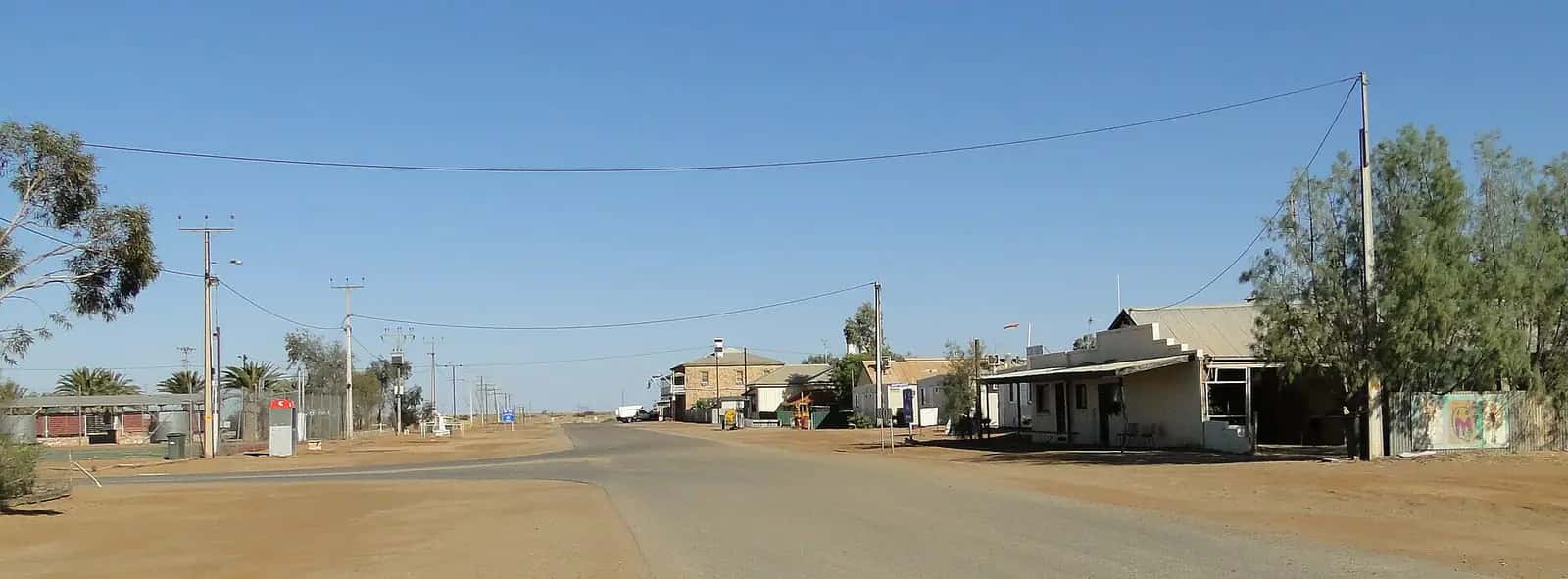
Marree, on Arabana and Dieri Country about 680 km north of Adelaide, grew around the railway that later became known as the Ghan. Afghan and other cameleers based here carried supplies to remote stations, and the town's mosque, built in the 1880s, is often described as Australia's first. The original Outback Now covered the Marree Camel Cup, which still attracts links from 4WD and touring sites.
Things to do
Railway heritage. Old Ghan locomotives and the railway precinct recall the line that once ran north to Alice Springs.
Mosque replica and cameleer history. A replica mosque and displays honour the cameleers.
Lake Eyre (Kati Thanda) flights. Scenic flights leave from Marree to see the salt lake, especially spectacular when it holds water.
Marree Man. The giant geoglyph etched into a plateau west of town in 1998 has largely faded; flights sometimes point out its location.
Hotel and pub. The historic Marree Hotel is the social hub.
History and Country
Marree is on the Country of the Arabana and Dieri peoples. Explorers, including John McDouall Stuart, passed through the region in the 1850s and 1860s. In 1883 the Great Northern Railway from Port Augusta reached Marree (then called Hergott Springs), and the town became a railhead for the far north. From here, Afghan cameleers transported goods to stations and remote settlements, and stockmen drove cattle south along the Birdsville Track to the railhead. The town was renamed Marree in 1918. The railway was later extended north to Oodnadatta and Alice Springs, and was replaced by a new standard gauge line further west in 1980.
Cameleers
Marree was one of the main bases for the cameleers — men from Afghanistan, northern India and surrounding regions — who worked in the outback from the 1860s to the early twentieth century. Many settled in the town, and their descendants still live in South Australia. A replica of the mosque that once stood in Marree commemorates their community.
Lake Eyre (Kati Thanda)
Kati Thanda–Lake Eyre is Australia's largest salt lake and the lowest point on the continent, about 15 m below sea level. It fills only occasionally, after heavy rain in Queensland flows down the rivers of the Channel Country. When water arrives, birdlife flocks to the lake. Scenic flights from Marree and William Creek are the best way to see it. Visitors driving to the lake via Muloorina need a Desert Parks Pass.
The tracks
Marree is the starting point for two famous outback routes:
- The Birdsville Track, about 520 km north to Birdsville.
- The Oodnadatta Track, about 620 km to Marla, passing William Creek and Oodnadatta, and following the old Ghan railway and mound springs.
Both are unsealed and close after rain. Check South Australia's outback road warnings.
Seasons
April to October is most comfortable. Summer temperatures are extreme, and services may operate reduced hours.
Getting there
Marree is about 680 km north of Adelaide; the road from Lyndhurst is sealed. Fuel is available in town.
Where to stay
The Marree Hotel, a caravan park and camping.
Safety
Carry plenty of water and fuel, spare tyres and a satellite communication device. Tell someone your plans.
The Marree Man
In 1998, a giant figure of an Aboriginal hunter, about 4.2 km long, was discovered etched into the ground on a plateau west of Marree. It was spotted by a charter pilot and became an international mystery, as no one claimed responsibility. The figure faded over time; it was partly re-graded in 2016 by locals but has since weathered. It is visible only from the air.
The Old Ghan railway
The narrow-gauge Central Australia Railway reached Marree in 1883 and Oodnadatta in 1891, and was eventually extended to Alice Springs in 1929. The line was notorious for delays caused by floods and washaways. It was replaced in 1980 by a new standard-gauge line further west. In Marree, old locomotives and rolling stock are displayed near the former station.
Camel heritage
Afghan cameleers set up a camp on the northern side of town, known as the Ghantown. They carried goods across the outback and played a crucial role in the development of central Australia. A camel statue and the replica mosque mark their legacy.
Who it suits
Marree suits travellers heading along the Oodnadatta or Birdsville tracks, history buffs and anyone wanting to see Lake Eyre. It is a good overnight stop before tackling the tracks.
Where to next
- Lyndhurst and Leigh Creek — south, towards the Flinders Ranges.
- Lake Eyre South — a short side trip north along the Oodnadatta Track.
- William Creek and Coober Pedy — west via the Oodnadatta Track.
- Birdsville — north via the Birdsville Track.
Tom Kruse and the Birdsville mail run
Marree was the base for one of the outback's best-known mail runs. The State Library of South Australia's SA History Hub tells the story of Tom Kruse:
- The run. Kruse drove the Marree to Birdsville mail run for Harry Ding in a Leyland diesel truck. The 523 km route crossed many sand dunes, and its dry rivers were prone to flash flooding.
- His own business. He later bought Ding's mail contract and ran the service from Marree.
- The film. In 1952 and 1953, John Heyer and the Shell Film Unit followed the run up the Birdsville Track. The result, The Back of Beyond, won the Grand Prix Assoluto at the 1954 Venice Biennale.
- Honours and later years. Kruse received an MBE in 1955 for services to the Royal Mail. He sold the run in 1957 and abandoned the Leyland on Pandie Pandie Station near Birdsville.
- The truck's return. The truck was recovered in 1993 and rebuilt, and Kruse re-ran the mail route in 1999. Bronze busts of him were unveiled in 2008 at places including the National Motor Museum. He died in 2011.
Marree was also the northernmost railhead in central Australia in the 1890s. The History Hub says the brothers Faiz and Tagh Mahomet then owned more than 900 camels and employed around 100 cameleers there. Camel routes ran north to Oodnadatta and Alice Springs, and north-east to Birdsville.
See our Birdsville Track guide and cameleers history.
Practical information
Marree has fuel, a store, a hotel, a caravan park and camping. It is the start of the Birdsville Track and the Oodnadatta Track to William Creek. See outback camel races.
The Marree Hotel features in our guide to famous outback pubs.
Up the Oodnadatta Track: Coward Springs.
Related park guide: Wabma Kadarbu Mound Springs.
Frequently asked questions
Is the road to Marree sealed?
The road from Leigh Creek and Lyndhurst to Marree is sealed. The Oodnadatta and Birdsville tracks beyond Marree are unsealed.
What is the Marree Camel Cup?
A camel racing event held in Marree in some years, run by the local community. Check the official event channels for future dates.
What is the history of Marree, South Australia?
Marree grew as a railhead on the old Ghan line and a base for Afghan cameleers. The SA History Hub says camel routes ran from Marree to Oodnadatta, Alice Springs and Birdsville. Tom Kruse later ran the Birdsville mail run from the town, made famous by the 1954 film The Back of Beyond.
Sources and further reading
Facts on this page were checked against these primary and official sources. Conditions change — confirm before you travel or buy.
- Outback road warnings — Department for Infrastructure and Transport SA
- Flinders Ranges and Outback — Marree — South Australian Tourism Commission
- Tom Kruse — SA History Hub (State Library of South Australia)
- Afghans — SA History Hub (State Library of South Australia)