Camels were imported to Australia from the 1860s. The Burke and Wills expedition used camels in 1860, and from the 1860s onward thousands more were imported, along with cameleers. Although commonly called "Afghans", the men came from Afghanistan, Baluchistan, Punjab, Sindh and other regions.
Work on the tracks
Camel trains carried wool, food, mail and equipment between railheads and remote stations and mines. They supported the building of the Overland Telegraph Line and the railways. Cameleers were based at Marree, Oodnadatta, Bourke, Broken Hill and other towns.
Mosques
Australia's earliest mosques were built by cameleers. The mosque at Marree, built in the 1880s, is often described as the first. The Broken Hill mosque, built in 1891, survives and can be visited.
Decline
Motor vehicles and railways replaced camel trains from the 1920s and 1930s. Many camels were released, and their descendants form today's large feral camel population.
Sites to visit
- Marree — replica mosque and cameleer history. See Marree.
- Broken Hill — the historic mosque. See Broken Hill.
- Bourke — cameleer history. See Bourke.
- The Ghan — the train named after the cameleers. See Adelaide to Darwin.
Why camels
Inland Australia posed a transport problem for the colonies. Horses and bullocks needed regular water and feed, and wagons struggled across sandhills and gibber plains. Camels could carry heavy loads, travel long distances between waterholes and eat a wide range of desert plants. After their use on the Burke and Wills expedition, pastoralist Thomas Elder of South Australia imported a large shipment of camels and handlers in 1866 to his Beltana station in the Flinders Ranges, and the camel transport industry grew from there.
Who the cameleers were
The cameleers were mostly Muslim men from British India and Afghanistan, including Pashtun, Baluch and Punjabi men. They came on contracts, usually without their families, and many returned home after a few years. Others stayed, married locally — including Aboriginal women and European women — and established families whose descendants live in Australia today. They brought their faith, food and customs, built the first mosques, and created camps on the edges of towns, often called "Ghantowns".
The camel trains
A camel string could include dozens of animals, roped nose to tail and led by a cameleer on foot. They carried wool bales from stations to railheads, and returned with food, building materials, mining equipment and mail. Camels helped supply construction camps on the Overland Telegraph Line, the early railways and mining fields in Western Australia, South Australia and western New South Wales. They also accompanied many later exploring and survey expeditions, including Alfred Canning's survey of the Canning Stock Route.
Railheads such as Hergott Springs (later renamed Marree), Oodnadatta, Bourke and Farina became busy camel depots. From Marree, camel trains headed north along what is now the Birdsville Track and west along the route of the Oodnadatta Track.
Discrimination
Despite their essential role, cameleers faced hostility and discrimination. Some European carriers and teamsters resented the competition, and from 1901 the Immigration Restriction Act — the foundation of the White Australia policy — made it difficult for cameleers to bring families or return to Australia after visiting home. Many older men lived out their lives in the Ghantowns or in the mosques they had built.
The Ghan
The railway from Port Augusta to Oodnadatta and later Alice Springs, opened in stages from the late nineteenth century to 1929, became known as "the Afghan Express" and then "the Ghan" in recognition of the cameleers. Today's Ghan passenger train between Adelaide, Alice Springs and Darwin follows a newer standard-gauge line, and its logo features a cameleer and camel.
Feral camels today
When camel trains were no longer needed, many camels were released into the bush. Their descendants have built up a large feral population across central Australia. Feral camels damage waterholes, vegetation and infrastructure, and governments and Aboriginal ranger groups run management programs. On the road, camels are a collision hazard, especially at night; see Kangaroos, emus and driving safety.
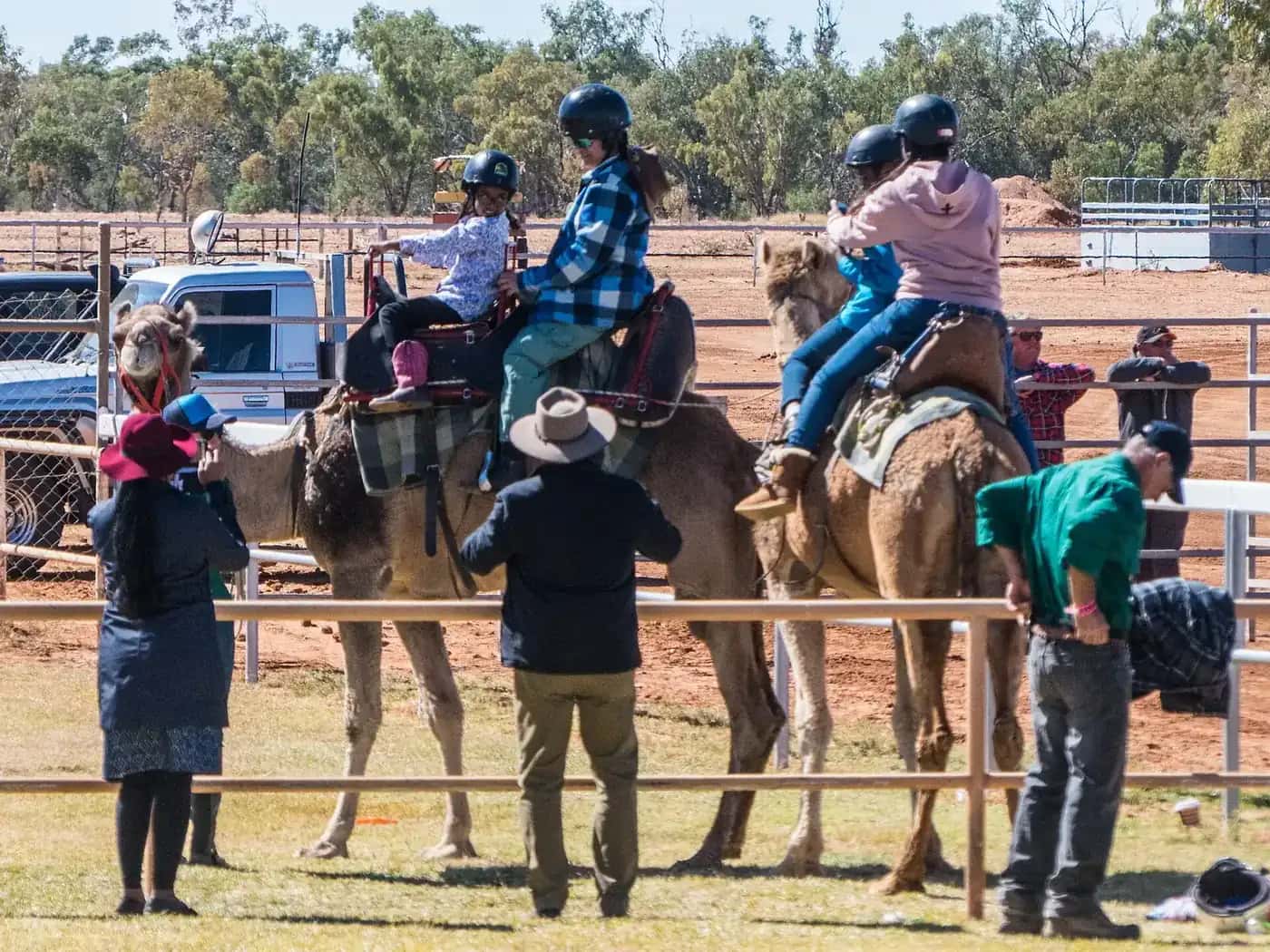
Camel tourism is a more positive legacy: camel rides and treks operate around Uluru, Alice Springs and Broome, and camel races are held in outback towns.
Visiting cameleer heritage
- Marree — a reconstructed mosque, interpretive signs and a camel sculpture tell the story of the cameleers who once made this one of the outback's busiest depots.
- Broken Hill — the mosque, built by cameleers in 1891, is cared for by the Broken Hill Mosque Museum, and open at set times; check with the visitor centre.
- Farina — the ruins of a railway town near Marree, being restored by volunteers, with interpretive material on the era.
- Alice Springs — museums cover the camel era in central Australia.
Legacy
Descendants of cameleer families live across Australia, and community groups, historians and museums have worked to record their stories through oral history projects and exhibitions. The cameleers' contribution is now widely recognised as central to opening up the inland, and their mosques are among Australia's earliest Islamic heritage sites.
Frequently asked questions
Why were camels brought to Australia?
Camels could carry heavy loads across arid country where horses and bullocks struggled. They were imported for exploration, construction and transport.
Where did the cameleers live?
Many lived in "Ghantowns" on the edge of outback towns such as Marree, Oodnadatta, Bourke, Broken Hill and Alice Springs.
Sources and further reading
Facts on this page were checked against these primary and official sources. Conditions change — confirm before you travel or buy.
- National Museum of Australia — National Museum of Australia
- Australian camel (Wikipedia) — Wikipedia