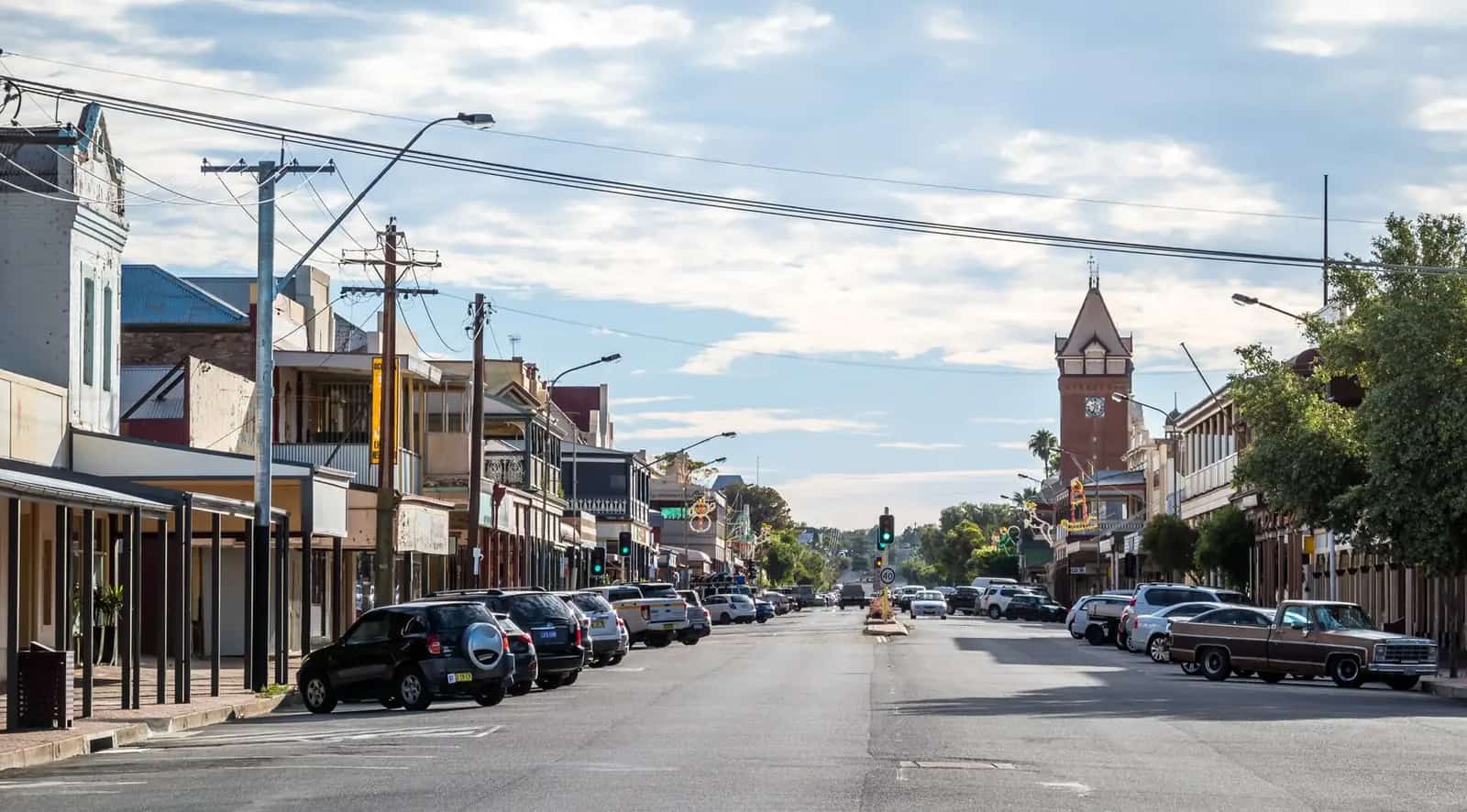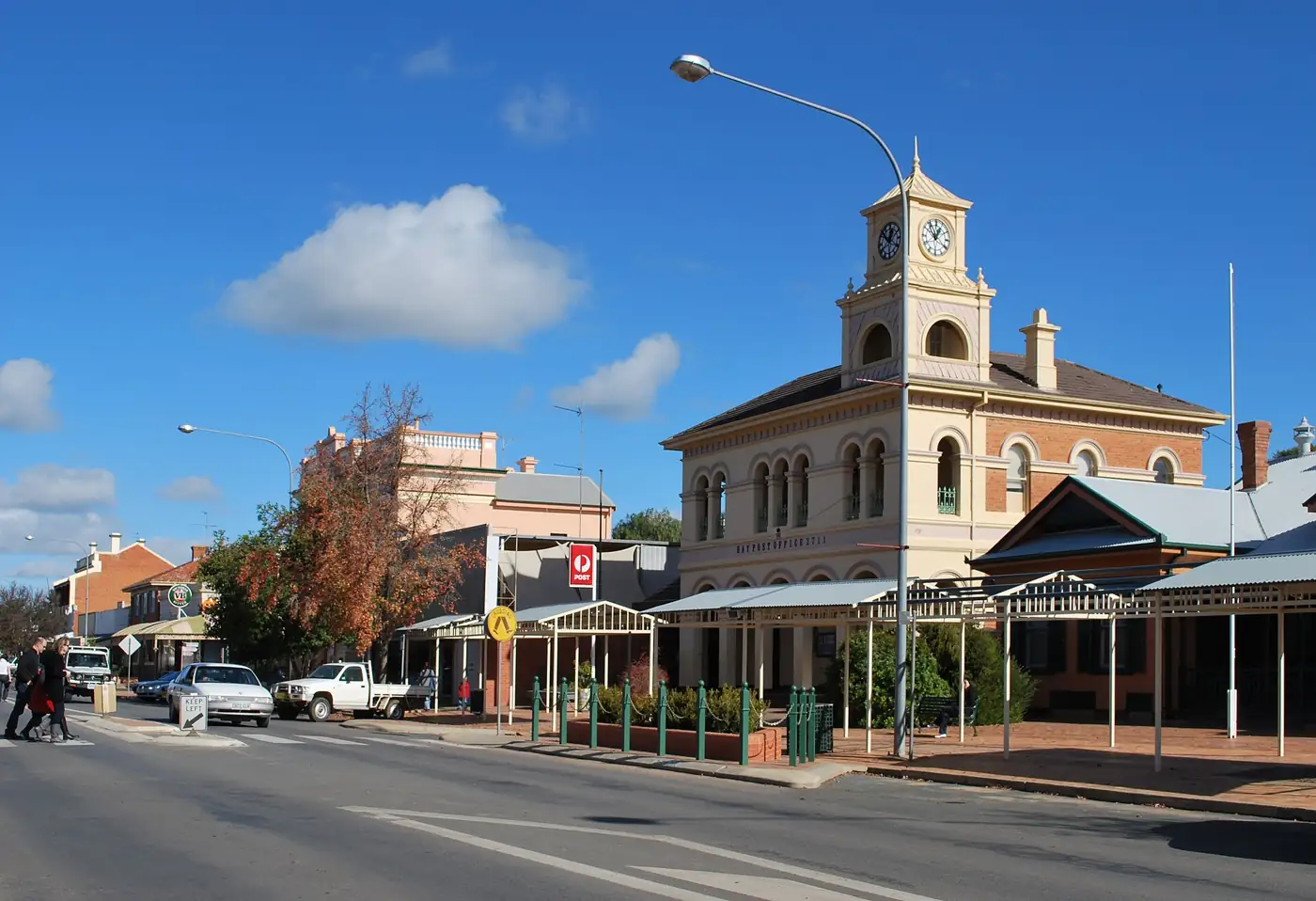
Hay lies at the junction of the Sturt, Cobb and Mid Western highways on the Murrumbidgee River. It is on the Country of the Nari Nari people and neighbouring groups. The Hay Plains, stretching in every direction, are among the flattest landscapes in Australia.
History
Hay grew from a river crossing in the 1850s and became a port and service centre for pastoral stations. Wool and Cobb & Co coaches shaped its early history.
During the Second World War, internment and prisoner-of-war camps operated at Hay. In 1940 the "Dunera boys", mostly German and Austrian Jewish refugees deported from Britain on HMT Dunera, were held here. Many later contributed greatly to Australian life. The Dunera Museum, in old railway carriages at Hay station, tells their story.
Things to do
- Shear Outback — the Australian Shearers' Hall of Fame, with shearing demonstrations and the historic Murray Downs woolshed.
- Hay Gaol Museum — the old gaol, which also served as a maternity hospital and later an institution for girls.
- Bishop's Lodge — a historic residence and garden.
- Murrumbidgee River walks and beaches.
- Sunset on the Hay Plains — vast skies and horizons.
Getting there and services
Hay is a full-service town with accommodation, fuel and supermarkets.
The Hay Plains
West and north of Hay, the Hay Plains stretch to the horizon in every direction, covered with saltbush and grasses. The stretch of the Sturt Highway across One Tree Plain is one of the flattest drives in Australia. At sunset, the sky seems enormous. The plains are home to the rare plains-wanderer, a small ground-dwelling bird that birdwatchers travel from around the world to see, usually on organised night tours with local guides.
Hay and Booligal
Banjo Paterson's poem Hay and Hell and Booligal jokingly ranked the district's towns by heat, dust and flies. Booligal, a tiny settlement north of Hay on the Cobb Highway, is still a stop for travellers on the Long Paddock touring route, which follows the Cobb Highway from the Murray River to Wilcannia along an old stock route.
The Long Paddock
The Long Paddock touring route follows the Cobb Highway north from Echuca–Moama through Deniliquin and Hay to Ivanhoe and Wilcannia. Interpretive signs along the way tell stories of droving, Cobb & Co coaches and the people of the plains. See our droving and stock routes guide.
Shear Outback
Shear Outback is a museum dedicated to Australia's shearing history, with interactive displays, regular shearing demonstrations and the relocated Murray Downs woolshed. It is a great introduction to the wool industry that built much of inland Australia.
Getting there
Hay is at the junction of the Sturt Highway (Sydney/Canberra to Adelaide), the Cobb Highway (Murray River to Wilcannia) and the Mid Western Highway (from Bathurst). It is roughly 720 km from Sydney and around 420 km from Melbourne. Mildura is about four hours west.
Where to stay
Hay has motels, caravan parks (some by the river) and hotel accommodation. The riverside reserves along the Murrumbidgee are popular.
Suggested day
Visit Shear Outback in the morning, then the Dunera Museum and Hay Gaol. After lunch, explore Bishop's Lodge and walk along the Murrumbidgee. Drive out onto the plains for sunset.
Tips
- Watch for wildlife on the plains at dawn and dusk.
- Check museum hours before you go.
- Bring a hat: there is little shade on the plains.
Wartime Hay
Hay hosted several camps during the Second World War. As well as the Dunera internees, the camps held Italian and Japanese internees and prisoners of war at different times. The internees organised schools, concerts and newspapers, and some produced their own camp currency. Many of the Dunera internees were later released, and some became prominent scientists, artists and academics in Australia. Interpretive signs and the Dunera Museum help visitors understand this period.
When to visit
Spring and autumn are ideal. Summers are hot, and winter mornings can be frosty.
Plains-wanderers and grassland birds
The native grasslands of the Hay Plains are one of the strongholds of the plains-wanderer, a small, critically endangered ground bird found only in eastern Australia. Seeing one is a highlight for serious birdwatchers, and local guides have run night tours on private properties in the past. Ask at the Hay visitor centre about current options, and never enter private land without permission. After rain, the grasslands also attract brolgas, raptors such as black falcons and spotted harriers, and flocks of small seed-eating birds.
A farming district
Hay is surrounded by merino sheep country, and some of the district's stud properties have long histories in the wool industry. Irrigation along the Murrumbidgee supports crops on some properties, while beef cattle are run across the region. Harvest and shearing seasons bring extra activity, and the town's businesses serve a wide pastoral district.
Camping by the river
Riverside reserves along the Murrumbidgee near town offer camping among the river red gums, with sandy beaches in low water. Check council rules on where camping is permitted and for how long, take all rubbish with you and camp well back from the bank in case of rising water.
Stargazing
The flat, open plains and dark skies around Hay make it a great place to watch the stars on clear nights. Drive a short distance out of town, park well off the road and let your eyes adjust.
Crossing the plains safely
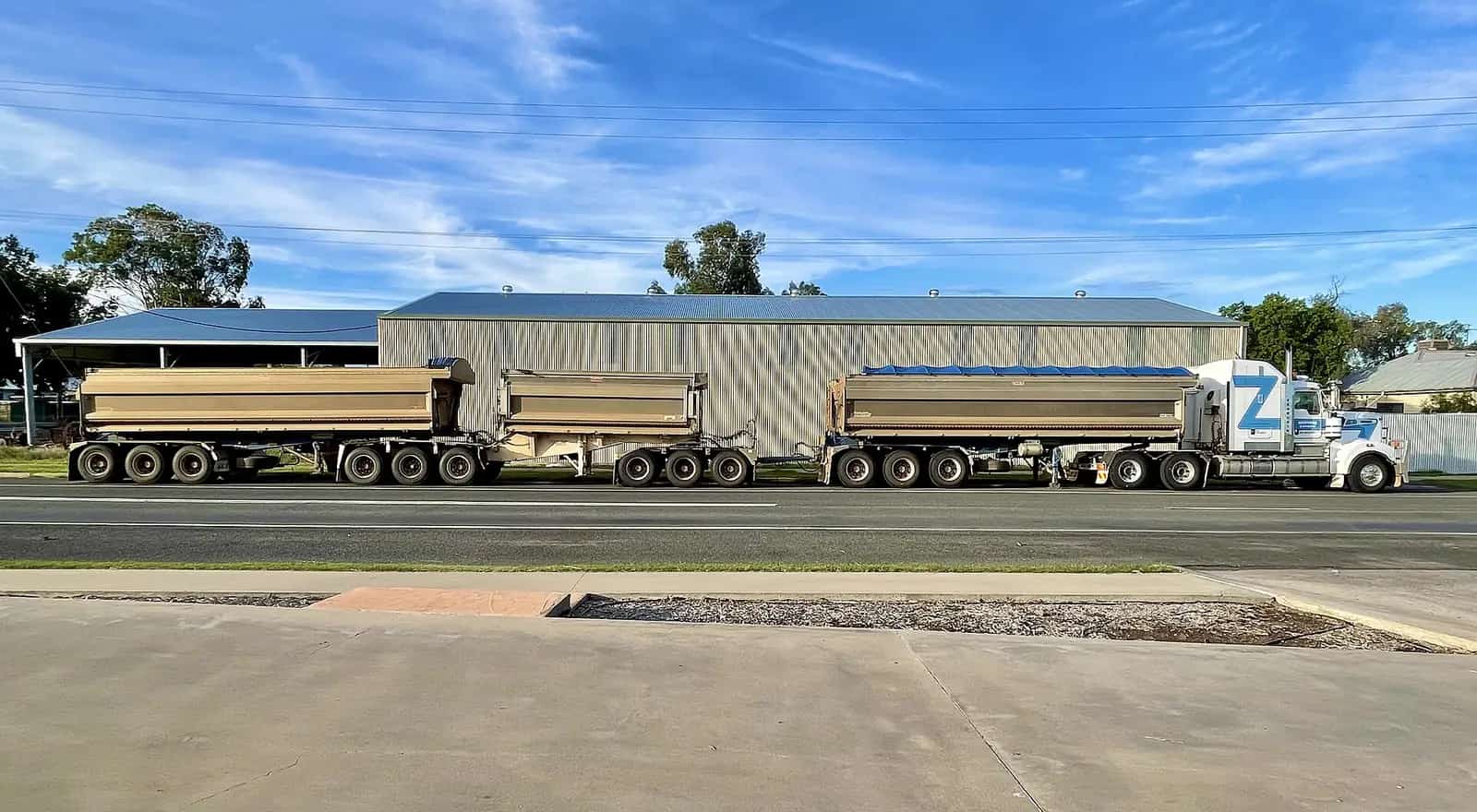
The highways across the Hay Plains are long, straight and flat, and fatigue is a real risk. Stop at rest areas, share the driving and avoid night driving, when kangaroos, emus and stock are most active. Strong crosswinds can affect caravans on the open plains. See kangaroos and driving safety.
Hay's museums
Visit Hay lists several museums in town:
- Shear Outback, the Australian Shearers' Hall of Fame, on the corner of the Sturt and Cobb highways.
- Dunera Museum, at the railway station on Murray Street. It tells the story of more than 6,000 German, Italian and Japanese civilian internees and prisoners of war held in three camps at Hay during and after the Second World War. Open daily, 9 am to 5 pm.
- Hay Gaol Museum, on Church Street. The gaol was built in 1878 and has been a community museum since 1976. It has also served as a maternity hospital and an institution for girls. The collection includes what Visit Hay calls Australia's oldest known bark canoe. Open daily, 9 am to 5 pm.
- Bishop's Lodge, on Roset Street. An 1888 iron house designed by architect John Sulman to cope with Hay's summer heat.
- Hay War Memorial High School Museum, on Pine Street. The school opened on Anzac Day 1923 as the town's war memorial.
Down by the Murrumbidgee, Sandy Point Beach has white sand, lawns and amenities. The Bidgee Riverside Trail follows the river through Bushy Bend Reserve, past large public sculptures. Bikes can be hired from the visitor centre. Check current opening hours before you visit.
Practical information
- Nearest towns: Balranald (west), Narrandera (east), Booligal (north).
- Best time: spring and autumn.
Related park guide: Willandra.
Across the Murray, the Victorian outback centres on Mildura and the Mallee.
Frequently asked questions
How far is Hay from Sydney and Melbourne?
Hay is about 720 km west of Sydney via the Sturt Highway, and roughly 420 km north of Melbourne via the Cobb Highway.
What is Hay NSW known for?
Hay is known for the vast, flat Hay Plains, Shear Outback (the Australian Shearers' Hall of Fame), its Second World War internment camps and the Dunera Museum, and its heritage gaol and Bishop's Lodge.
What were the Hay internment camps?
During the Second World War, camps at Hay held internees and prisoners of war, including the "Dunera boys" — mostly Jewish refugees from Europe deported from Britain in 1940.
Is Hay, NSW in the Outback?
Hay is in the western Riverina, on the edge of the vast, treeless Hay Plains. Many travellers treat it as the gateway to outback NSW. The Cobb Highway runs north from Hay towards Ivanhoe and Wilcannia.
Is Hay, NSW worth visiting?
Yes, especially as an overnight stop. Hay has Shear Outback, the Dunera Museum, the Hay Gaol Museum, river beaches on the Murrumbidgee and famous Hay Plains sunsets.
Sources and further reading
Facts on this page were checked against these primary and official sources. Conditions change — confirm before you travel or buy.
- Live Traffic NSW — Transport for NSW
- Hay Shire Council — Hay Shire Council
- Shear Outback — Shear Outback
- Hay (Wikipedia) — Wikipedia
- Explore Hay — Visit Hay