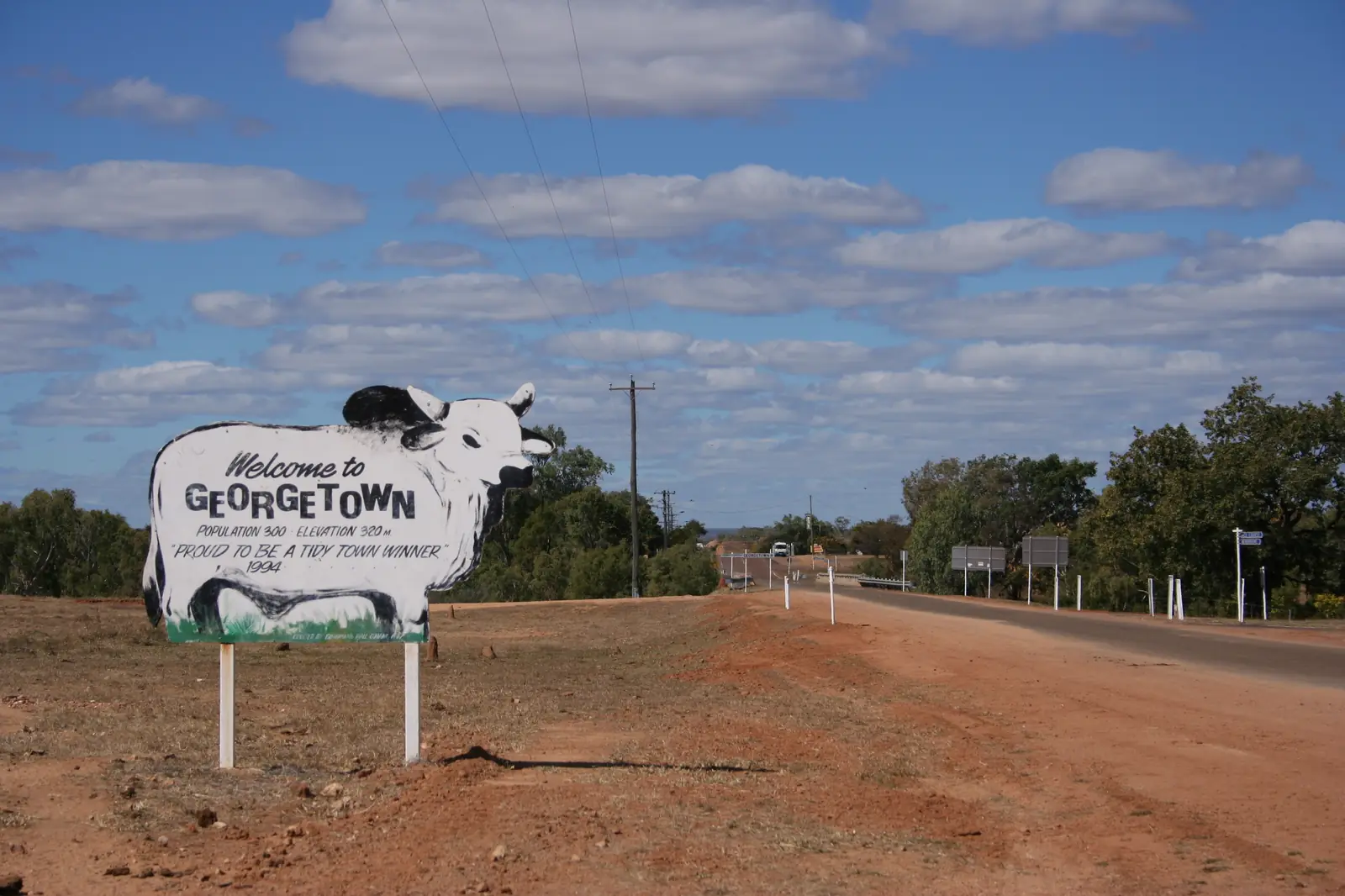
Georgetown sits on the Gulf Savannah at two Bureau of Meteorology sites used in this guide. Georgetown Airport (030124) is the current climate-averages table: commenced 2004, 18.30°S, 143.53°E, elevation 302 m, status Open. Georgetown Post Office (030018) is the long record: commenced 1872, 18.29°S, 143.55°E, elevation 292 m; the summary page fetched for this research listed latest available data 31 July 2009. Figures will drift as years are added. Always open BOM before you treat a number as current.
Product date on the airport summary used here: 14 November 2026.
This page does not fill empty cells from memory. Our outback weather by month guide explains how to read inland columns generally.
Georgetown Airport (030124) — current means
Hottest and coolest months below are the months with the highest and lowest mean maximum temperature.
| Period | Mean maximum (°C) | Mean minimum (°C) | Mean rainfall (mm) | Mean days rain ≥ 1 mm |
|---|---|---|---|---|
| January | 33.9 | 23.4 | 257.4 | 13.4 |
| February | 33.3 | 22.9 | 214.4 | 11.6 |
| March | 33.5 | 22.0 | 137.1 | 8.8 |
| April | 32.9 | 19.5 | 23.1 | 2.2 |
| May | 30.5 | 16.6 | 12.8 | 1.0 |
| June | 28.9 | 14.0 | 7.7 | 0.7 |
| July (coolest mean max) | 28.8 | 13.2 | 10.2 | 0.9 |
| August | 30.5 | 13.7 | 1.4 | 0.2 |
| September | 33.7 | 17.0 | 5.7 | 0.7 |
| October | 36.3 | 20.6 | 14.0 | 2.2 |
| November (hottest mean max) | 36.9 | 22.9 | 77.6 | 5.3 |
| December | 36.3 | 23.7 | 143.2 | 8.3 |
| Annual | 33.0 | 19.1 | 843.4 | 55.3 |
Temperature means on that table use 22 years (2004–2026). Rainfall mean uses 16 years in the annual row as published. August is the driest month (1.4 mm). January is the wettest (257.4 mm). Full columns including extremes: BOM Georgetown Airport.
Georgetown Post Office (030018) — long record
Use this table for depth, not as a substitute for the airport’s current means.
| Period | Mean maximum (°C) | Mean minimum (°C) | Mean rainfall (mm) | Mean days rain ≥ 1 mm |
|---|---|---|---|---|
| January | 34.4 | 22.9 | 224.9 | 10.8 |
| February | 33.6 | 22.7 | 212.9 | 10.4 |
| March | 33.4 | 21.5 | 123.1 | 6.3 |
| April | 32.5 | 19.4 | 28.8 | 2.0 |
| May | 30.4 | 16.1 | 9.3 | 0.8 |
| June | 28.2 | 13.0 | 10.4 | 0.9 |
| July | 28.2 | 12.0 | 6.7 | 0.6 |
| August | 30.0 | 13.1 | 4.3 | 0.4 |
| September | 33.0 | 16.2 | 6.4 | 0.5 |
| October | 35.8 | 19.7 | 16.7 | 1.5 |
| November | 36.7 | 21.8 | 50.7 | 4.0 |
| December | 36.1 | 22.8 | 127.8 | 7.4 |
| Annual | 32.7 | 18.4 | 819.8 | 45.6 |
Rainfall years: 134 (1872–2009). Temperature years differ by element (mean max 98 years, 1909–2007 on that page). Clear-day annual mean 164.6; cloudy-day annual mean 55.4. BOM Georgetown Post Office.
What the averages mean on the ground
Summer. January’s 257.4 mm at the airport is a wet-season figure, not a Channel Country sprinkle. The Gulf Developmental Road and the Forsayth–Cobbold gravel both take water. Check QLDTraffic (13 19 40) rather than assuming the 92 km to Mount Surprise is always easy. Mean maxima stay in the mid-30s all summer; November 36.9 °C is the peak on the airport table. A midday Heritage Park walk is unpleasant. A motel room or cabin is the conservative overnight. See wet season and road closures.
Winter. July’s 28.8 °C mean maximum is mild only by comparison with November. It is still warm walking weather. July mean minimum 13.2 °C (airport) or 12.0 °C (post office) is the cool night. Pack a layer. This is when the TerrEstrial runs seven-day hours (April–September).
Rainfall shape. Roughly 800–850 mm a year, almost all of it November–March. August’s 1.4 mm at the airport is why people call this a dry-season touring town. Averages are not a forecast.
When to visit Georgetown
- April to September — the TerrEstrial’s seven-day season, lowest rain, the usual Savannah Way window. Book accommodation.
- October — hours drop to weekdays at the VIC; November heat is coming; rain is still modest (14.0 mm mean at the airport in October, 77.6 mm in November).
- November–March — possible if you have air-conditioning, spare days and a QLDTraffic habit. Undara and Cobbold Gorge seasons are operator and Parks questions; do not assume summer tours.
See best time to visit the outback. Georgetown is hotter in July than Tambo or Dalby; it is not a hill station at 302 m.
Combining weather with a trip plan
Lava-tube tours and gorge boats run on operator calendars, not on a mean-max column. Ask at 20 Low Street. After rain, even sealed highway floodways close; gravel to Cobbold Gorge is worse.
For towing, wet grass on park sites after January storms is as much a problem as the highway. See Georgetown caravan parks. Carry water even in the dry — August’s 1.4 mm is not a reason to skip drinking water.
Related
Plan this trip
Tell us the dates, who you are travelling with and where you need help. We reply with planning notes for Georgetown — we are not a booking agent.
Frequently asked questions
What is the hottest month in Georgetown?
At Georgetown Airport (030124), November has the highest mean maximum, 36.9 °C. At Georgetown Post Office (030018), November is also the hottest mean maximum, 36.7 °C.
How wet is Georgetown in summer?
Airport January mean rainfall is 257.4 mm; August is 1.4 mm. Annual mean rainfall is 843.4 mm. The Gulf Developmental Road still closes in the wet — check QLDTraffic.
Should I use the airport or the post office table?
Use the airport for current means (commenced 2004, still open). Use the post office for the long rainfall story (commenced 1872; latest data on the summary page used here 31 July 2009).
Sources and further reading
Facts on this page were checked against these primary and official sources. Conditions change — confirm before you travel or buy.
- Climate statistics for Georgetown Airport (030124) — Bureau of Meteorology
- Climate statistics for Georgetown Post Office (030018) — Bureau of Meteorology
- Georgetown (L) 2021 Census QuickStats — Australian Bureau of Statistics
- QLDTraffic — Queensland Government
- Outback weather by month — Outback Now